

Table of Contents
- History of LiFePO4
- What is LiFePO4 Battery?
- How Does a LiFePO4 Battery Work?
- Key Components
- Advantages of LiFePO4
- Disadvantages of LiFePO4
- Common Applications
- Environmental Benefits
- Understanding the Lifespan
- Charging Guide
- How to Store LiFePO4 Batteries
- Maintenance Tips
- Safety Features
- LiFePO4 vs Lithium-ion
- LiFePO4 vs Lead Acid
- Buying Guide
- Common Myths
- Conclusion
- FAQs
In the rapidly evolving world of renewable energy and off-grid power solutions, selecting the right energy storage technology is absolutely critical. Over the past decade, a specific chemistry has risen to dominate the industry, pushing older technologies aside. If you are exploring solar setups, upgrading your RV, or looking for a reliable home backup, you have likely asked yourself: what is a lifepo4 battery, and why is everyone recommending it?
A LiFePO4 battery (Lithium Iron Phosphate Battery) is currently recognized as one of the safest, most durable, and highly efficient rechargeable battery chemistries available on the market today. Offering immense improvements over traditional deep cycle battery types, this technology is revolutionizing how we store and consume energy.
In this comprehensive guide, we will dive deep into everything you need to know about the LiFePO4 lithium battery. From its internal chemical composition and outstanding advantages to its ideal applications and how it compares against traditional lead-acid and standard lithium-ion batteries.
History of LiFePO4 Battery
LiFePO4 battery technology was first discovered by researchers at the University of Texas, led by Dr. John B. Goodenough. Since then, it has become one of the most trusted lithium battery chemistries due to its exceptional safety, long lifespan, and thermal stability.
What is LiFePO4 Battery?
A LiFePO4 battery stands for Lithium Iron Phosphate battery. It is a subset of the broader lithium-ion battery family. The name is derived from its chemical makeup: Lithium (Li), Iron (Fe), and Phosphate (PO4). Discovered in the late 1990s, this specific cathode material completely changed the landscape of energy storage.
Unlike standard lithium batteries that use cobalt or manganese (which can be toxic, expensive, and prone to overheating), the Lithium Iron Phosphate battery utilizes non-toxic, abundant materials. This fundamental shift in chemistry results in a deep cycle battery that boasts unprecedented thermal stability and an exceptionally long cycle life.
LiFePO4 batteries are entirely cobalt-free. Cobalt is a heavy metal used in standard lithium-ion batteries that is highly controversial due to environmental concerns and unethical mining practices. Choosing LiFePO4 is an environmentally responsible choice.
How Does a LiFePO4 Battery Work?
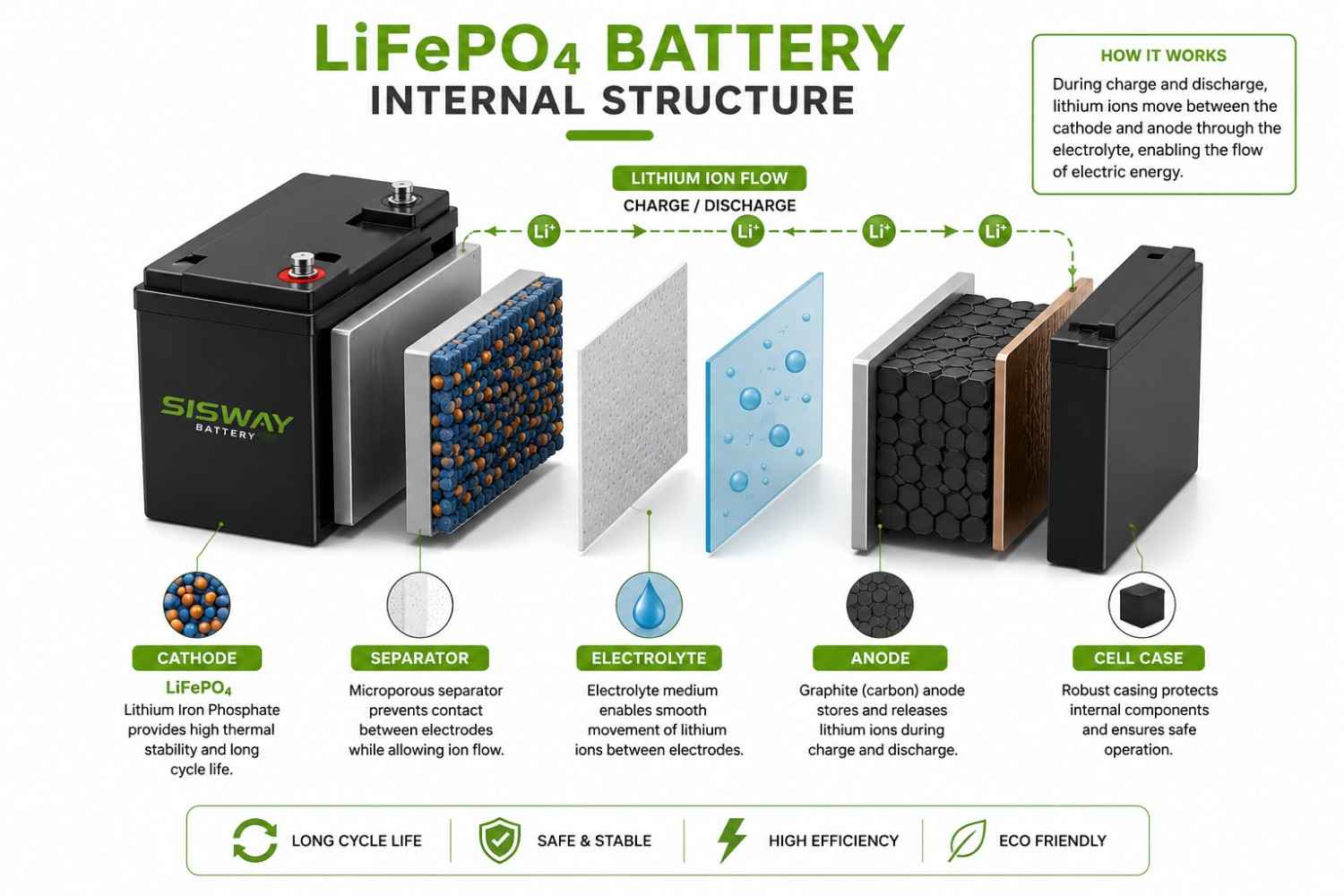
At its core, a LiFePO4 battery generates electricity through a chemical reaction that moves lithium ions between a positive and negative electrode. When you use the battery to power a device (discharging), lithium ions move from the graphite anode to the lithium iron phosphate cathode. This movement releases electrons, which travel through an external circuit, providing power to your devices.
During the charging process, this action is reversed. Electrical current forces the lithium ions back from the cathode across the electrolyte and into the graphite anode, storing energy for future use. Because the phosphate-based atomic lattice is incredibly stable, this back-and-forth movement can happen thousands of times with minimal degradation.
Key Components
To fully understand a LiFePO4 battery, we need to look at its internal structure. A standard battery pack consists of four primary internal components:
- Cathode (Positive Electrode): Made from Lithium Iron Phosphate, this determines the battery’s capacity, voltage, and incredible thermal stability.
- Anode (Negative Electrode): Typically made of graphite (carbon), acting as a reservoir for lithium ions during charging.
- Electrolyte: A liquid or polymer substance that acts as a pathway, allowing lithium ions to flow freely between the anode and cathode.
- Separator: A porous membrane that keeps the anode and cathode physically separated to prevent short circuits while allowing ions to pass through.
Advantages of LiFePO4 Batteries
The rise in popularity of the LiFePO4 lithium battery is not a coincidence. It is driven by a long list of superior performance metrics compared to older technologies.
Long Lifespan
Easily surpass 3,000 to 5,000 cycles at an 80% Depth of Discharge (DoD), translating to over 10 years of daily use.
Excellent Safety
Superior thermal and chemical stability makes them virtually incombustible and highly resistant to thermal runaway.
Lightweight
Weighs roughly one-third of a comparable lead-acid battery, vastly improving handling, range, and installation ease.
High Efficiency
Deep cycle LiFePO4 batteries maintain high usable capacity across a wide range of discharge rates. Fast-charging enables true opportunity charging.
Eco-Friendly
Non-toxic, fully sealed by design, and completely cobalt-free. They are the greenest choice for modern energy storage.
Zero Maintenance
No watering, no terminal cleaning, and no acid checks required. Install them once and enjoy reliable power.
Disadvantages of LiFePO4 Batteries
While the benefits are overwhelming, it is important to understand the minor drawbacks to make an informed decision.
Higher Initial Cost
The upfront cost of a LiFePO4 battery is noticeably higher than a traditional lead-acid battery. However, because they last up to ten times longer, the overall cost per cycle is significantly lower, making them the most cost-effective choice in the long run.
Lower Energy Density
Compared to other lithium-ion chemistries (like NMC used in cell phones and some EVs), LiFePO4 has a lower energy density. This means they are slightly larger and heavier than other lithium types for the same capacity. However, they are still drastically lighter than lead-acid.
Cold Weather Performance
Standard LiFePO4 batteries cannot be charged below freezing temperatures (0°C / 32°F) without causing irreversible damage. High-quality batteries counter this by implementing built-in heating pads controlled by the BMS to safely warm the battery before accepting a charge in cold climates.
Never attempt to charge a standard LiFePO4 battery in below-freezing temperatures unless it is specifically equipped with low-temperature charging protection or internal heaters. Doing so will permanently destroy the battery cells.
Common Applications
Thanks to their high discharge rates, durability, and safety, LiFePO4 batteries are versatile and utilized across various demanding industries:
- Solar Systems & Home Energy Storage: Their ability to handle deep cycling daily makes them the ultimate solar LiFePO4 battery for off-grid homes and commercial solar arrays.
- RVs and Marine Batteries: Their lightweight nature and vibration resistance make them perfect for motorhomes, sailboats, and trolling motors.
- Electric Vehicle Battery & Golf Carts: Perfect for high-performance golf carts, EVs, and industrial equipment requiring consistent, long-lasting power.
- Portable Power Stations: High energy delivery in a compact, portable form factor.
- Medical Equipment: Provides uninterrupted, safe power to critical life-saving machinery.
- Telecom Backup & Data Centers: Trusted for reliable, low-maintenance power during grid failures.
- UPS Systems: Essential for continuous Uninterruptible Power Supply systems.
- Robotics & Agricultural Equipment: Rugged enough to handle heavy vibrations and extreme environments.
Environmental Benefits of LiFePO4 Batteries
A core reason the rechargeable LiFePO4 battery has overtaken the market is its impressive eco-friendly profile:
- No Cobalt: Unlike traditional lithium-ion batteries, LiFePO4 uses zero cobalt, avoiding unethical mining practices and heavy metal toxicity.
- No Lead or Acid: Completely eliminates the risk of toxic lead exposure or acid spills.
- Non-toxic & Safe: The phosphate chemistry is non-hazardous, making disposal and handling much safer.
- Lower Carbon Footprint: Due to higher efficiency and fewer replacements, the overall manufacturing footprint over 10 years is drastically reduced.
- Recyclable: The core components (iron, phosphate, aluminum) are highly recyclable.
- Reduces Waste: A 10+ year lifespan means significantly fewer batteries ending up in landfills compared to replacing lead-acid batteries every two years.
LiFePO4 vs Lead Acid
To truly appreciate the technology, let’s look at how it compares to the legacy lead-acid deep cycle battery.
| Feature | LiFePO4 Battery | Lead-Acid Battery |
|---|---|---|
| Lifespan | 3,000 to 5,000+ Cycles | 300 to 500 Cycles |
| Weight | Very Lightweight (~1/3 of Lead Acid) | Extremely Heavy |
| Usable Capacity | Up to 100% Depth of Discharge | Max 50% Depth of Discharge |
| Charging Speed | Fast (1 to 3 hours) | Slow (8 to 12 hours) |
| Maintenance | Zero Maintenance | Requires regular watering & cleaning |
| Long-term Cost | Highly Cost-Effective | Expensive (frequent replacements) |
LiFePO4 vs Lithium-ion (NMC/NCA)
It is easy to confuse LiFePO4 with standard lithium-ion, but their characteristics are quite different.
| Feature | LiFePO4 (Lithium Iron Phosphate) | Lithium-ion (NMC/Cobalt) |
|---|---|---|
| Safety & Thermal Stability | Exceptional (Very low risk of thermal runaway due to excellent thermal stability) | Moderate (Risk of thermal runaway) |
| Cycle Life | 3,000 – 5,000 Cycles | 500 – 1,000 Cycles |
| Energy Density | Lower (Slightly larger footprint) | High (Very compact) |
| Environmental Impact | Non-toxic, Cobalt-free, Eco-friendly | Contains toxic heavy metals (Cobalt) |
- Lithium typically pays back its premium within 3-5 years via maintenance savings alone.
- Avoiding 5+ lead-acid replacements adds thousands in savings over 10 years.
- Always opt for LiFePO4 over standard lithium-ion for large-scale energy storage due to its superior safety and lifecycle.
Understanding the Lifespan
The lifespan of a LiFePO4 lithium battery is categorized by “charge cycles.” A charge cycle is one full discharge and one full recharge. If you only discharge the battery 50% and recharge it, that is merely half a cycle. Because these batteries easily withstand 3,000 to 5,000 cycles, an off-grid cabin cycling the battery daily will see well over a decade of reliable performance. Even after hitting its cycle threshold, the battery doesn’t die; it simply drops to about 80% of its original capacity and continues working.
Charging Guide
Proper charging is crucial. While a built-in battery management system (BMS) protects the internal cells, you must use a dedicated LiFePO4 battery charger. Standard lead-acid chargers often include an “equalization” phase which sends high voltage spikes that can permanently damage a lithium battery. Ensure your solar charge controller, alternator DC-DC charger, or shore power charger is set to a dedicated “LiFePO4” or “Lithium” profile.
| Battery Size | Approx Charging Time (with recommended charger) |
|---|---|
| 50Ah | 1–2 Hours |
| 100Ah | 2–4 Hours |
| 200Ah | 4–6 Hours |
How to Store LiFePO4 Batteries
When not in use, storing your battery properly ensures it maintains its total lifespan:
- 40–60% Charge: Do not store the battery at 100% or 0% for long periods. Keeping it at 40-60% preserves cell health.
- Cool, Dry Location: Keep it away from moisture and humidity.
- Avoid Direct Sunlight: UV exposure and excessive heat degrade the battery case and internal chemistry.
- Recharge Every 6 Months: LiFePO4 batteries have a very low self-discharge rate (approx 2% per month), but they should be topped up every 6 months to prevent over-discharging.
- Storage Temperature: Aim for room temperature storage (around 15°C to 25°C / 59°F to 77°F) for optimal preservation.
Maintenance Tips
One of the greatest joys of owning a LiFePO4 deep cycle battery is the lack of maintenance. However, applying a few best practices will ensure maximum longevity:
- Keep the battery terminals clean and tightly secured.
- Avoid discharging the battery entirely to 0% on a regular basis. Aim for a 10-20% minimum buffer.
- Store the battery in a cool, dry place if not in use for extended periods.
Safety Features and the BMS
What truly sets a modern LiFePO4 battery apart is its brain: the Battery Management System (BMS). The BMS is an internal circuit board that constantly monitors the battery. It protects against:
- Over-charging and Over-discharging.
- Short circuits and reverse polarity.
- Temperature extremes (both hot and cold).
- Cell balancing (ensuring all internal cells maintain identical voltage).
Voltage Options: 12V vs 24V vs 48V
Choosing the correct voltage is fundamental when sizing your battery bank. Here is a quick breakdown to help you decide which voltage fits your needs best:
Buying Guide: What to Look For
Not all batteries are created equal. When sourcing a LiFePO4 battery, consider the following parameters:
- Capacity (Ah) & Voltage (V): Ensure the battery size matches your energy demands and inverter voltage (typically 12V, 24V, or 48V).
- Battery Management System (BMS): Ensure the BMS rating matches your max continuous discharge needs. A 100Ah battery with a 100A BMS can power a 1200W inverter continuously.
- Temperature Rating: If you live in a cold climate, ensure you purchase a battery with low-temperature charging protection or internal heating.
- Brand Reputation & Warranty: Look for brands offering a solid warranty (5 to 10 years) and proven customer support.
When wiring multiple LiFePO4 batteries in parallel or series, ensure all batteries are of the exact same brand, capacity, and age. Fully charge each battery individually before connecting them together to ensure proper cell balancing across the bank.
When selecting the best LiFePO4 battery, choose one with an integrated Battery Management System (BMS), high-quality Grade A cells, and a manufacturer warranty of at least five years. These factors significantly improve reliability, safety, and long-term value.
Common Myths
Myth 1: LiFePO4 batteries catch fire easily.
False. This is a confusion with standard lithium-ion batteries. The phosphate chemistry in LiFePO4 makes
thermal runaway nearly impossible.
Myth 2: You have to fully discharge them before charging.
False. LiFePO4 batteries do not suffer from “memory effect”. You can charge them regardless of their
current capacity state without causing harm.
Conclusion
Transitioning to a LiFePO4 battery is undeniably one of the most impactful upgrades you can make for any solar setup, RV, or marine vessel. Their phenomenal safety profile, unmatched lifespan, zero maintenance, and lightweight design cement them as the superior energy storage solution of our generation. While the initial investment might seem steep, the long-term savings and peace of mind make them worth every penny.
Frequently Asked Questions (FAQs)
A LiFePO4 battery, or lithium iron phosphate battery, is a type of rechargeable lithium-ion battery known for its high safety, exceptional thermal stability, and long cycle life. It is widely utilized for solar energy storage, EVs, RVs, and marine applications.
A standard LiFePO4 battery typically lasts between 3,000 to 5,000 charge cycles depending on depth of discharge and usage. With proper care, this translates to a lifespan of 10 years or more, vastly outperforming traditional lead-acid batteries.
Yes, in many critical aspects. While standard lithium-ion batteries may have slightly higher energy density, LiFePO4 batteries are significantly safer, far less prone to thermal runaway (catching fire), and offer a much longer cycle lifespan.
Yes, LiFePO4 batteries are designed as excellent drop-in replacements for lead-acid batteries. They provide more usable capacity, weigh a fraction of the amount, and charge much faster. You only need to ensure your charger supports a lithium charge profile.
LiFePO4 batteries are among the safest lithium batteries available globally. Their stable chemical structure makes them highly resistant to thermal runaway, combustion, and explosions even under extreme physical conditions or overcharging.
Unlike lead-acid batteries that should only be discharged to 50%, LiFePO4 batteries can safely be discharged up to 90-100% of their capacity. The internal BMS will automatically cut off power to prevent harmful over-discharge.
Absolutely. In fact, LiFePO4 batteries are the preferred choice for modern solar energy storage systems due to their high charge/discharge efficiency, fast charging capabilities, and ability to easily handle daily deep discharge cycles.
Depending on the charger’s output rating and the battery’s total capacity, a LiFePO4 battery can generally be fully charged in 1 to 3 hours. This rapid acceptance rate is up to four times faster than a comparable lead-acid battery.
No, LiFePO4 batteries are completely sealed and practically maintenance-free. They do not require watering, equalizing charges, or acid specific gravity checks like traditional flooded lead-acid batteries.
Yes. Despite a higher initial upfront cost, their incredibly long lifespan, high efficiency, zero maintenance needs, and robust safety profile make them highly cost-effective and a much smarter investment over their entire lifecycle.
Looking for Premium LiFePO4 Batteries?
Sisway Battery offers reliable, long-lasting LiFePO4 batteries for:
- Solar Systems
- • RVs
- • Marine
- • Golf Carts
- • Home Backup
- • Industrial Equipment