

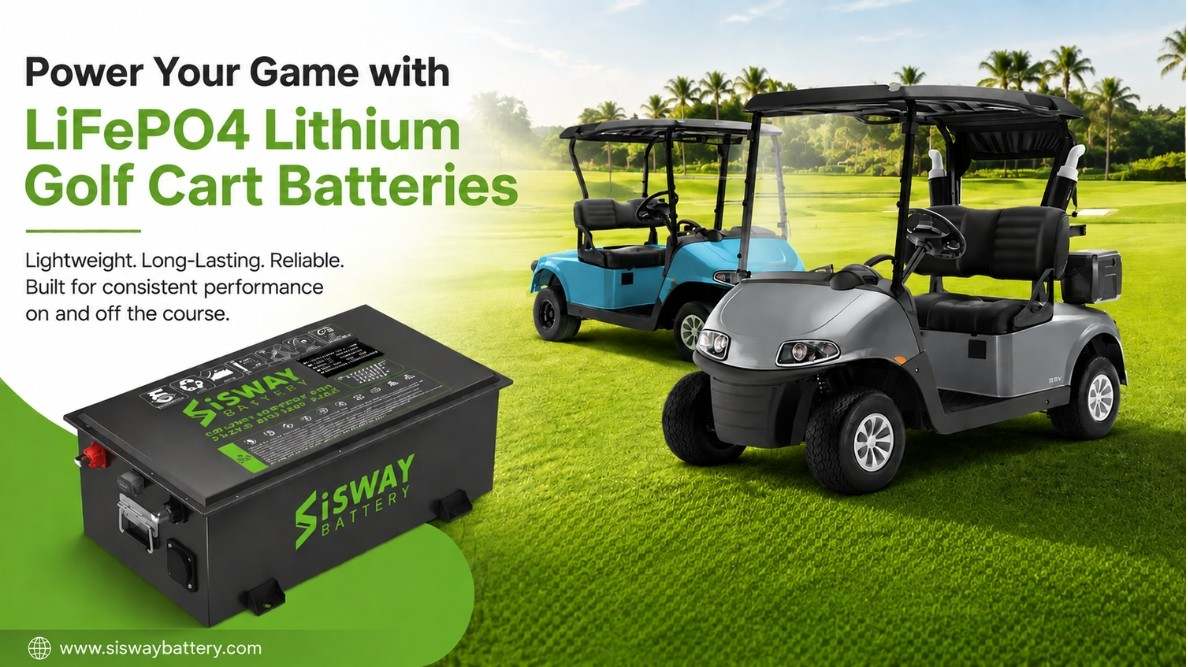
If your golf cart is running on an aging lead-acid pack, you’ve probably noticed the symptoms: shrinking range, slower acceleration on hills, and a charging routine that never seems to end. A 60V lithium golf cart battery addresses all three of these pain points, which is why more owners, dealers, and fleet operators are making the switch.
This guide walks through how 60V lithium batteries work, what actually determines your golf cart’s range, how charging works, and what to check before you buy — without the inflated claims you’ll find on a lot of battery websites.
What Is a 60V Lithium Golf Cart Battery?
A 60V lithium golf cart battery is a rechargeable power source built around lithium iron phosphate (LiFePO4) cells, configured to deliver a nominal 60 volts of output. It replaces the traditional bank of six 10V (or similar) lead-acid batteries that many golf carts have relied on for decades.
The “60V” refers to the voltage — essentially the electrical pressure that drives your cart’s motor. The battery’s capacity, measured in amp-hours (Ah), tells you how much energy it can store and deliver over time. A 60V 100Ah battery, for example, stores more usable energy than a 60V 50Ah battery, which directly affects how long you can drive between charges.
Unlike lead-acid chemistry, LiFePO4 cells are wired together with a battery management system (BMS) — a small onboard computer that monitors voltage, temperature, and current across each cell. The BMS protects against overcharging, over-discharging, and short circuits, which is a big part of why lithium batteries tend to be more reliable over the long run.
Sisway Battery’s 60V lithium golf cart battery lineup is built specifically for carts and light utility vehicles that run on this voltage class.
How Does a 60V Lithium Golf Cart Battery Work?
At a basic level, the battery stores energy chemically and releases it as electrical current when the golf cart’s motor calls for power. Here’s the simplified sequence:
- Discharge — When you press the accelerator, the motor controller draws current from the battery pack. The BMS continuously checks that voltage and temperature stay within safe limits.
- Power delivery — Lithium cells maintain a more stable voltage curve than lead-acid as they discharge, which means your cart’s power output feels more consistent from a full charge down to a low one.
- Recharge — When you plug in, the charger sends current back into the cells. The BMS balances the charge across individual cells so none of them get overcharged, which helps preserve long-term battery health.
This cycle — discharge, monitor, recharge — repeats thousands of times over the life of a well-maintained lithium battery, which is part of why cycle life tends to be substantially higher than lead-acid.
How Far Can a 60V Lithium Golf Cart Battery Go?
This is the question most buyers actually care about, and it’s also the one with the least straightforward answer. Range depends on several variables working together, not on voltage alone.
Factors that affect golf cart range:
Battery Ah Capacity
Higher amp-hour ratings generally mean more stored energy and more potential range, all else being equal.
Golf Cart Weight
Heavier carts (especially those with added accessories like coolers, lift kits, or extra seating) require more energy to move.
Passenger & Cargo Load
More weight on board means the motor works harder, which draws more current per mile.
Driving Speed
Higher speeds increase energy consumption disproportionately due to rolling resistance and drivetrain losses.
Terrain
Hills and uneven ground demand significantly more power than flat, paved paths.
Tire Pressure
Underinflated tires increase rolling resistance and reduce efficiency.
Driving Conditions
Frequent stop-and-start driving (like on a crowded golf course) uses more energy than steady cruising.
Temperature
Battery performance can dip somewhat in very cold conditions, similar to most lithium battery types.
Battery Age & Condition
Like any battery, usable capacity can decline gradually as a pack goes through more charge cycles over its service life.
Because these variables interact, we won’t quote a single “guaranteed miles” figure here — anyone who does is oversimplifying. Instead, it’s worth thinking in terms of your specific use case: a golf course fleet cart doing short, repeated trips will use energy very differently than a personal cart doing longer neighborhood rides. For exact range and capacity specifications on a given model, check the product listing or speak with Sisway Battery’s team directly.
60V Golf Cart Battery Charging Time
Charging time isn’t a fixed number either — it depends on the battery’s Ah capacity, the charger’s output current, and how depleted the battery was to begin with. A larger capacity battery paired with a lower-amperage charger will naturally take longer than a smaller battery on a higher-output charger.
A few things that matter for charging:
- Charger compatibility – Lithium batteries require a charger designed for LiFePO4 charging profiles. Using a charger built for lead-acid batteries isn’t recommended, since the voltage curves and charge termination logic are different.
- Charging behavior – Lithium batteries generally accept charge efficiently through most of the charging cycle, then taper off near full charge as the BMS manages individual cell balancing.
- Partial charging – Unlike lead-acid batteries, which are often charged fully every time to avoid sulfation, lithium batteries tolerate partial charging well. Topping off after a short round of golf, rather than waiting for a full discharge, doesn’t harm the battery the way it might with lead-acid.
- No need to “condition” the battery – Lithium chemistry doesn’t require the periodic equalization charges that lead-acid batteries often do.
We won’t state an exact charging time here, since it varies by model and charger — check your specific battery’s documentation or the 60V lithium golf cart battery category page for details on individual products.
Benefits of a 60V Lithium Golf Cart Battery
Compared to traditional lead-acid batteries, lithium golf cart batteries offer several practical advantages:
Longer Service Life
LiFePO4 cells typically handle significantly more charge cycles before capacity degrades meaningfully, compared to flooded lead-acid batteries.
Lower Maintenance
No water topping off, no terminal corrosion to clean, and no acid to handle.
More Efficient Charging
Lithium batteries generally charge faster and with less energy loss than lead-acid.
Consistent Power Delivery
The voltage stays more stable throughout the discharge curve, so your cart doesn’t feel noticeably sluggish as the battery drains.
Lighter Weight
Lithium batteries are considerably lighter than equivalent lead-acid banks, which can improve handling and reduce strain on the cart’s suspension and drivetrain.
Higher Usable Capacity
Lead-acid batteries typically shouldn’t be discharged below 50% regularly without shortening their lifespan, while lithium batteries can safely use a much larger portion of their rated capacity.
Reduced Long-Term Upkeep
Fewer maintenance tasks translate to less time spent on battery care over the ownership period.
These are general characteristics of LiFePO4 technology rather than specific performance guarantees, and actual results vary by usage pattern and model.
60V Lithium vs. Lead-Acid Golf Cart Batteries
| Factor | 60V Lithium (LiFePO4) | 60V Lead-Acid |
|---|---|---|
| Weight | Significantly lighter | Heavier |
| Lifespan (cycles) | Generally much higher cycle life | Shorter cycle life |
| Charging | Faster, more efficient charging | Slower, less efficient |
| Maintenance | Minimal — no watering or terminal cleaning | Regular watering and terminal maintenance required |
| Usable capacity | Higher percentage of rated capacity usable | Typically limited to ~50% depth of discharge for longevity |
| Performance | Stable voltage output through discharge | Voltage drops more noticeably as it discharges |
| Long-term value | Higher upfront cost, often lower cost per cycle over time | Lower upfront cost, higher replacement frequency |
Both chemistries have their place. Lead-acid remains a lower-cost entry point, while lithium tends to make more sense for owners and fleets prioritizing longevity, reduced maintenance, and consistent performance over the ownership period.
What Should You Check Before Buying a 60V Golf Cart Battery?
Before purchasing, it’s worth confirming the following:
- Voltage compatibility – Make sure your golf cart’s electrical system is designed for 60V. Installing the wrong voltage battery can damage the motor controller.
- Ah capacity – Match the capacity to your typical usage — longer daily distances or heavier loads generally call for higher Ah ratings.
- Battery dimensions – Confirm the battery fits your cart’s existing battery compartment, or check what modifications might be needed.
- Weight – Even though lithium batteries are lighter, confirm the weight fits within your cart’s design specifications.
- Battery management system (BMS) – Look for a battery with a BMS that includes overcharge, over-discharge, short-circuit, and temperature protection.
- Charger compatibility – Confirm whether the battery includes a compatible charger or requires a specific lithium-rated charger.
- Cycle life – Ask for the manufacturer’s rated cycle life so you can estimate long-term value.
- Warranty coverage – Review what’s covered and for how long — this varies by manufacturer and model.
- Operating temperature range – Some batteries perform better in extreme heat or cold than others.
- Installation requirements – Determine whether professional installation is recommended, especially if you’re converting from lead-acid.
- Manufacturer support – Consider whether the manufacturer offers technical support, documentation, and responsive customer service.
If you’re unsure about any of these details for a specific model, it’s worth reaching out directly to the manufacturer before purchasing rather than assuming compatibility.
Is a 60V Lithium Battery Right for Your Golf Cart?
A 60V lithium battery tends to be a good fit for owners who:
- Currently run a 60V lead-acid system and want to upgrade within the same voltage class
- Use their cart frequently and are tired of regular lead-acid maintenance
- Want more consistent performance across a full charge cycle
- Are managing a fleet where downtime for battery maintenance adds up
- Plan to keep their cart for several years and want to reduce total battery replacement costs over that period
That said, voltage compatibility is non-negotiable. Before purchasing, verify your golf cart’s original electrical system specifications, either through the owner’s manual or by consulting the manufacturer. Installing a battery at the wrong voltage can cause serious damage to your cart’s motor controller and other components. If you’re converting from a different voltage system entirely, that’s a larger project than a straightforward battery swap.
Frequently Asked Questions
Conclusion
A 60V lithium golf cart battery can be a practical upgrade for owners looking to move past the maintenance demands and inconsistent performance of lead-acid batteries. With generally longer cycle life, lighter weight, and more efficient charging, lithium technology addresses many of the frustrations that come with older battery systems — as long as you confirm voltage compatibility and choose the right capacity for your needs.
Explore Sisway Battery’s 60V lithium golf cart battery solutions to find an option that matches your golf cart’s voltage, capacity and performance requirements.