1. What Is a 48V Lithium Golf Cart Battery?
A 48 volt lithium golf cart battery is a single, sealed pack that replaces a bank of lead-acid batteries. Most packs use LiFePO4 (lithium iron phosphate) cells. Because each cell has a nominal voltage of 3.2V, 16 cells in series give a nominal pack voltage of 51.2V. As a result, the rating is often written as 48V (51.2V).
In addition, LiFePO4 is known for its stable chemical structure and long cycle life. Meanwhile, a built-in Battery Management System (BMS) watches voltage, current and temperature. Because of this, the pack is protected against overcharge and short circuits.
2. How Many Miles Can a 48V Lithium Battery Power?
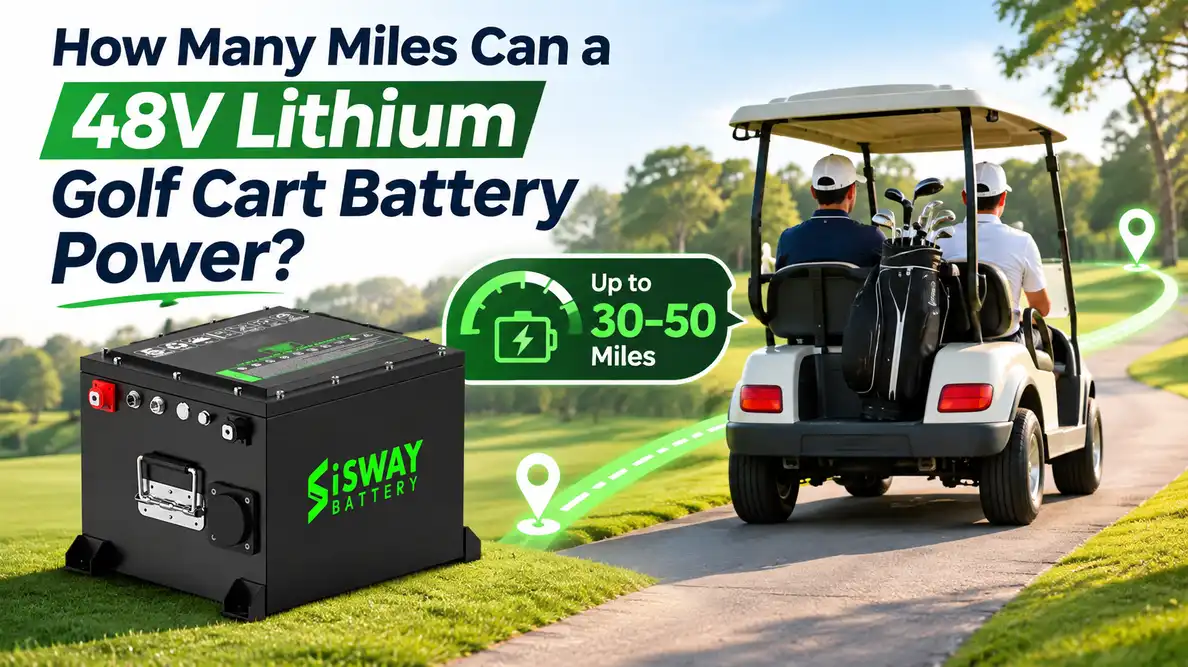
Quick answer: many 48V packs power a cart for roughly 15 to 35 miles per charge, although the exact figure depends on your setup. For instance, a 100Ah pack is often around 20 miles in mixed driving, while a 150Ah to 200Ah pack can go considerably further.
However, these figures are estimates, not guarantees. For example, a flat course with two riders uses far less energy than a hilly route with four passengers and cargo. Therefore, always confirm the capacity of the exact model on its product page.
3. How to Estimate Range From Capacity
First, capacity in amp-hours (Ah) shows how much charge the pack holds. Second, to find the energy in kilowatt-hours (kWh), multiply Ah by the pack voltage and divide by 1,000. Finally, divide the usable energy by how much energy your cart uses per mile.
Range Table by Pack Capacity
Although the table below uses a simple model, it gives a useful starting point. For one, it assumes 80 percent of the pack is usable, which leaves a reserve. In addition, it assumes energy use of about 0.12, 0.20 and 0.25 kWh per mile for light, typical and heavy duty. Because these are illustrative assumptions, your cart may differ.
| Capacity | Pack energy | Light duty | Typical use | Heavy duty |
|---|
| 50Ah | ~2.6 kWh | ~17 miles | ~10 miles | ~8 miles |
| 100Ah | ~5.1 kWh | ~34 miles | ~20 miles | ~16 miles |
| 150Ah | ~7.7 kWh | ~51 miles | ~31 miles | ~25 miles |
| 200Ah | ~10.2 kWh | ~68 miles | ~41 miles | ~33 miles |
While light duty means flat ground and one or two riders, heavy duty means hills, four passengers, cargo or large tires. Because models and dimensions vary, always confirm the exact specification before ordering.
4. Factors That Affect Your Real-World Miles
Because range depends on more than the battery, check these points when you compare your results with the estimate:
Battery CapacityBecause more Ah means more stored energy, capacity is the biggest single factor in how far you can go.
Terrain and HillsClimbing uses far more energy than flat ground, and as a result steep routes can cut range sharply.
Load and PassengersExtra riders and cargo add weight, and therefore energy use rises on every mile.
Speed and Driving StyleWhile faster speeds and hard acceleration use more power, steady, moderate driving saves energy.
Tires and Lift KitsBecause larger tires and lifted carts add drag and load, they lower range.
TemperatureCold weather can reduce available capacity, and consequently range drops in winter without a heating function.
5. How to Get More Miles From Each Charge
However, you can often stretch range without changing the pack by following the steps below.
Before You Drive
1Start With a Full ChargeFirst, charge to full before long routes. In addition, a lithium-compatible charger gives the right profile for LiFePO4 cells.
2Check Tire PressureBecause under-inflated tires increase rolling resistance, keep pressure at the recommended level.
Drive and Load Smartly
3Drive SmoothlyAvoid sudden acceleration and braking, because smooth driving uses less energy and extends range.
4Reduce Unneeded WeightRemove heavy items you do not need, because every extra pound uses energy.
Check Your Equipment
5Match the Controller and MotorMake sure the BMS discharge rating covers your controller’s continuous and peak current. Otherwise, the pack may cut power under load.
6Use a Lithium State-of-Charge GaugeA lead-acid voltage meter can misread lithium. Finally, use a gauge made for lithium, or a pack with a built-in display, for accurate range planning.
6. Where a 48V Lithium Pack Fits
Because a 48-volt platform serves many vehicle types, range needs differ, and common uses include:
Golf CartsClub CarsSightseeing VehiclesResort ShuttlesElectric Utility VehiclesCampus VehiclesHunting CartsCustom EV Projects
For example, a course cart that returns to the charger every evening needs far less range than a resort shuttle that runs all day.
7. How to Choose the Right Capacity for Your Range
First, note how far you drive in a typical day. Second, add a safety reserve of about 20 percent so that you never run the pack to empty.
| Vehicle Type | Duty | Suggested Capacity |
|---|
| Standard golf cart on a flat course | Short to medium daily routes | 50Ah to 100Ah |
| Hilly course or neighborhood cart | Hills, extra passengers | 100Ah to 150Ah |
| Utility, resort or campus vehicle | Long shifts, little downtime | 150Ah to 200Ah or a custom pack |
However, these are general suggestions, not fixed rules. In addition, our team can recommend a size based on your usage when your vehicle does not fit any row.
8. Common Range Mistakes to Avoid
Trusting One NumberA single figure ignores terrain, load and speed, so instead estimate for your own route.
Running to EmptyBecause the last 10 to 20 percent leaves no reserve for hills, plan to recharge early.
Keeping the Old ChargerBecause a lead-acid charger is not designed for LiFePO4, always use a matching lithium charger.
Ignoring the ControllerBecause a BMS rated below your controller’s demand may cut power during acceleration, always compare both ratings.
9. OEM and ODM Customization
Sisway works directly with golf cart manufacturers, distributors and private-label brands. Instead of forcing a standard catalog part into a non-standard vehicle, we build a pack around the exact specification your project needs.
What We Can Customize
Voltage and CapacityBattery SizeBMS ConfigurationCAN CommunicationRS485Bluetooth MonitoringHeating FunctionCharging ConnectorLogo PrintingPrivate LabelExport Packaging
How to Start an OEM Project
First, when you are sourcing a lithium golf cart battery manufacturer for a new build or fleet upgrade, tell us your range target, vehicle type and minimum order quantity (MOQ). As a result, we can help match a pack to your needs.
Find the Right 48V Battery for Your Cart
Sisway builds LiFePO4 packs with BMS protection for golf carts, resorts and utility vehicles. Because every cart differs, tell us your cart model, daily route and target miles, and we will help match capacity, mounting fit and charger. Additionally, ask about our OEM/ODM services for special requirements.
Get a Quote10. Frequently Asked Questions
Range and Basics
▾How many miles can a 48V lithium golf cart battery power?
Although many packs power a cart for roughly 15 to 35 miles per charge in typical use, the exact figure depends on capacity, terrain, load, speed and temperature.
▾How many miles does a 100Ah 48V lithium battery give?
Because a 100Ah pack holds about 5.1 kWh, it often gives around 20 miles with 80 percent usable and typical energy use. Of course, you will get more on flat ground and less on hills.
▾Does a lithium battery go farther than lead-acid?
Often yes in daily use, because lithium holds steady voltage for most of the discharge and the cart keeps its power. In addition, a lithium pack is much lighter.
Charging and Performance
▾How can I increase the range of my golf cart?
First, choose a larger capacity, keep tires inflated and drive smoothly. In addition, reduce extra weight and use a lithium-compatible charger.
▾Does cold weather reduce range?
Yes, because cold temperatures can reduce available capacity. However, an optional heating function supports charging and discharge in cold regions.
▾What BMS protection is included?
The BMS monitors voltage, current and temperature, and as a result it protects against overcharge, over-discharge and short circuits. In addition, custom BMS programming is available for OEM projects.
▾What charging method is recommended?
First, use a charger designed for 48V LiFePO4 packs. Second, partial charges are fine, because lithium has no memory effect.
Business and OEM
▾Can the battery be customized for OEM projects?
Yes, because every project differs, you can customize voltage, capacity, size, communication protocol, heating, connector and branding.
▾What warranty is offered on 48V lithium golf cart batteries?
Because warranty terms depend on the model and order type, contact our team for the current warranty details on your chosen pack.
▾Do you support OEM and bulk orders?
Yes, Sisway supports OEM, ODM and bulk orders, and in addition it provides export packaging and global shipping.