

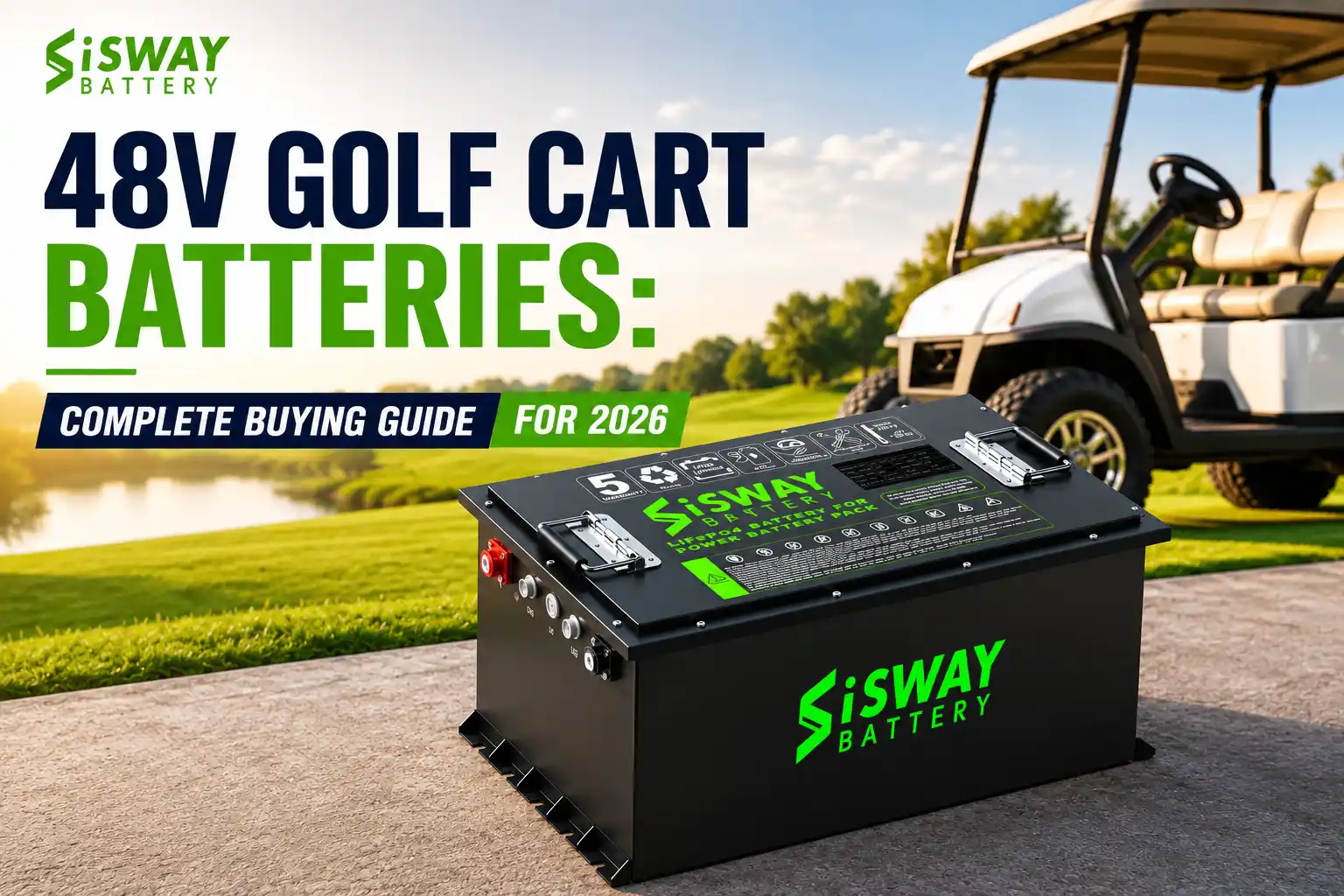
Thinking about ditching heavy lead-acid batteries? Here is a practical, straightforward look at how 48V lithium upgrades work, how to pick the right capacity, and how to get years of trouble-free driving out of your cart.
What’s in this guide
1. What Is a 48V Golf Cart Battery?
Specifically, if you own an electric golf cart or neighborhood cruiser built on a 48-volt system, your motor and controller rely on a 48V power source to get moving. For decades, as a result, that meant wiring together six 8-volt (or four 12-volt) heavy lead-acid batteries in series under the seat.
However, most cart owners today are replacing that entire cluster of heavy batteries with a single 48V lithium golf cart battery. In addition, these drop-in units use Lithium Iron Phosphate (LiFePO4) chemistry. Furthermore, inside the casing, an electronic Battery Management System (BMS) continuously balances the battery cells, controls current, and keeps everything running safely without any watering or terminal scraping on your part.
For instance, if you are looking to replace your current set, you can explore Sisway’s lithium golf cart battery collection which range from compact 100Ah packs for personal driving up to heavy-duty 315Ah units for full-day commercial use.
2. Why 48V Is the Industry-Standard Voltage for Golf Carts
Why do most major cart brands like Club Car, EZ-GO, and Yamaha use 48 volts? Essentially, it comes down to real-world power efficiency. Overall, a 48V setup gives your cart plenty of torque for carrying extra passengers and tackling steep hills, without needing the heavy industrial wiring or high-voltage safety precautions of bigger electric vehicles.
Because 48V is so widely used across the industry, single-pack lithium upgrades are built specifically to drop directly into standard 48V cart battery trays. As a result, that means fewer custom brackets and less hassle during installation.
3. 48V Lithium vs. Lead-Acid: Which Battery Wins?
Although lead-acid batteries might cost less when you buy them, they demand constant upkeep and usually wear out in 2 to 4 years. In contrast, lithium costs more upfront, but it lasts years longer, charges in a fraction of the time, and requires zero watering.
Real-World Performance Comparison
Below, here is how both battery technologies stack up in everyday use:
| What matters | 48V Lithium Battery | 48V Lead-Acid Batteries |
|---|---|---|
| Weight | 80–120 lbs total (shaves ~300 lbs) | 350–450 lbs for full set |
| Expected Lifespan | 3,500–4,000+ cycles (8–10+ years) | 300–500 cycles (2–4 years) |
| Charging Speed | Full charge in 2 to 4 hours | 8 to 12 hours overnight |
| Maintenance | Zero — sealed unit, no watering | Monthly distilled water & cleaning |
| Speed & Hill Power | Steady power all the way down to 5% | Cart slows down as battery drains |
4. Understanding Capacity: 100Ah, 105Ah, 150Ah, 200Ah & 315Ah
Amp-hours (Ah) tell you how far your cart can travel before needing a charge. Specifically, picking the right capacity comes down to how you actually drive your cart every day:
Matching Capacity Tiers to Your Driving Needs
- 100Ah or 105Ah: For example, this size is great for standard 2 to 4 seat personal carts. Consequently, it gives you roughly 25 to 35 miles per charge — plenty for 18–36 holes of golf or driving around the neighborhood.
- 150Ah: Meanwhile, this tier is best for 6-seater carts, lifted carts with bigger tires, or hilly neighborhoods where driving takes extra energy (40 to 55 miles range).
- 200Ah to 315Ah: In addition, these capacities are ideal for commercial maintenance fleets, resort shuttles, or rental carts that need to run non-stop all day long (65 to 100+ miles range).
Therefore, you can check full dimensions and specs for all capacity sizes on Sisway’s LiFePO4 battery pack selection page.
5. What You Actually Gain When Switching to Lithium
6. How to Choose the Right Battery for Your Cart
Before hitting buy, take a couple of minutes to double check these four essential checkpoints:
Pre-Purchase Verification Steps
- First, measure your battery bay: Make sure the single lithium unit fits comfortably into your cart’s tray.
- Second, check controller amp ratings: If your cart has a high-output aftermarket controller (e.g. 400A+), ensure the battery’s BMS peak current matches it.
- Third, get a lithium-compatible charger: Because lead-acid chargers push voltages that can trip a lithium BMS, use a charger rated for 58.4V LiFePO4 output.
- Finally, look for standard safety testing: Check that the battery carries UN38.3, CE, or ISO certifications for built-in cell safety.
7. Step-by-Step Battery Replacement
Swapping out your batteries is straightforward if you follow basic safety precautions.
Installation Walkthrough
- Disconnect Main Power: First, flip the key to off, set the cart’s switch to Tow mode, and unhook the main positive and negative cables.
- Remove Old Batteries & Clean Tray: Next, unbolt hold-downs, lift out the old lead-acid batteries, and give the tray a quick clean with baking soda and water to neutralize any dried acid.
- Position the Lithium Unit: Then, set your new 48V lithium pack into the tray and secure it firmly with the mounting brackets.
- Connect Terminal Leads: Afterwards, reconnect the main power leads to the battery terminals, matching positive (+) to positive and negative (-) to negative.
- Charge & Test Drive: Finally, plug in your new lithium charger for a full charge before taking your cart out on its first spin.
8. Charging Best Practices for 48V Lithium Batteries
Lithium batteries are easy to charge, but a couple of practical rules will keep them performing smoothly:
- First, always use a charger set specifically for LiFePO4 (58.4V max cutoff).
- In addition, don’t worry about letting the battery drain to 0% before plugging it in — lithium prefers partial recharges.
- Finally, avoid charging if the battery is sitting in freezing temperatures (unless your pack includes low-temp heating protection).
9. Keeping Your Battery Healthy in the Off-Season
When putting your cart away for the winter or leaving it idle for a few months, charge the battery to around 50% to 70%. Subsequently, turn off the battery breaker or Tow switch, and leave it in a dry spot. Because lithium self-discharges very slowly (<2% per month), as a result, you won’t need to leave a trickler running all winter.
Ready to Upgrade Your Golf Cart to Lithium?
Explore Sisway’s 48V lithium golf cart batteries and find the right capacity for your application.
Explore 48V Golf Cart Batteries10. Frequently Asked Questions
Here are answers to the 10 most common questions cart owners ask when upgrading to 48V lithium, organized into 3 natural sections.