
Why Standard Batteries Struggle in Cold Storage
Lead-acid batteries have powered industrial forklifts for decades, but sub-zero temperatures expose their fundamental limitations quickly. Understanding exactly where they fail is the first step toward choosing the right power system for your fleet.
- Severe capacity loss: At −20°C, a lead-acid battery loses 50% or more of its rated capacity — cutting an 8-hour shift down to just 4–5 hours of real runtime.
- Cannot charge inside the freezer: Batteries must be removed to a heated room, forcing operations to run 2–3 spare batteries per truck just to stay productive.
- Accelerated degradation: Repeated cold cycling shortens lead-acid lifespan to under 2 years in a −20°C environment versus 3–5 years in a temperate warehouse.
- High maintenance burden: Weekly watering, equalization charging, and terminal cleaning are difficult and hazardous in freezing conditions.
- Safety hazards: Hydrogen gas venting during charging requires specialized ventilated rooms; acid spills create ongoing corrosion and safety risks.
Industry data shows that a cold storage operation limited by lead-acid performance can experience 12 extra battery swaps per day, resulting in 6 hours of lost productivity daily. When unplanned downtime costs up to $10,000 per hour in missed throughput and cold-chain compliance failures, these inefficiencies become impossible to ignore.
How LiFePO4 Lithium Technology Solves Every Cold Storage Problem
Lithium Iron Phosphate (LiFePO4 or LFP) isn’t just a better version of lead-acid — it operates on fundamentally different principles that make it far more resilient at low temperatures. Here are the four key technologies that make the difference.
Cold-Stable Chemistry
LiFePO4 retains over 80% of rated capacity at −20°C before any heating activates — a structural advantage from its stable olivine crystal cathode.
Active Cell Heating
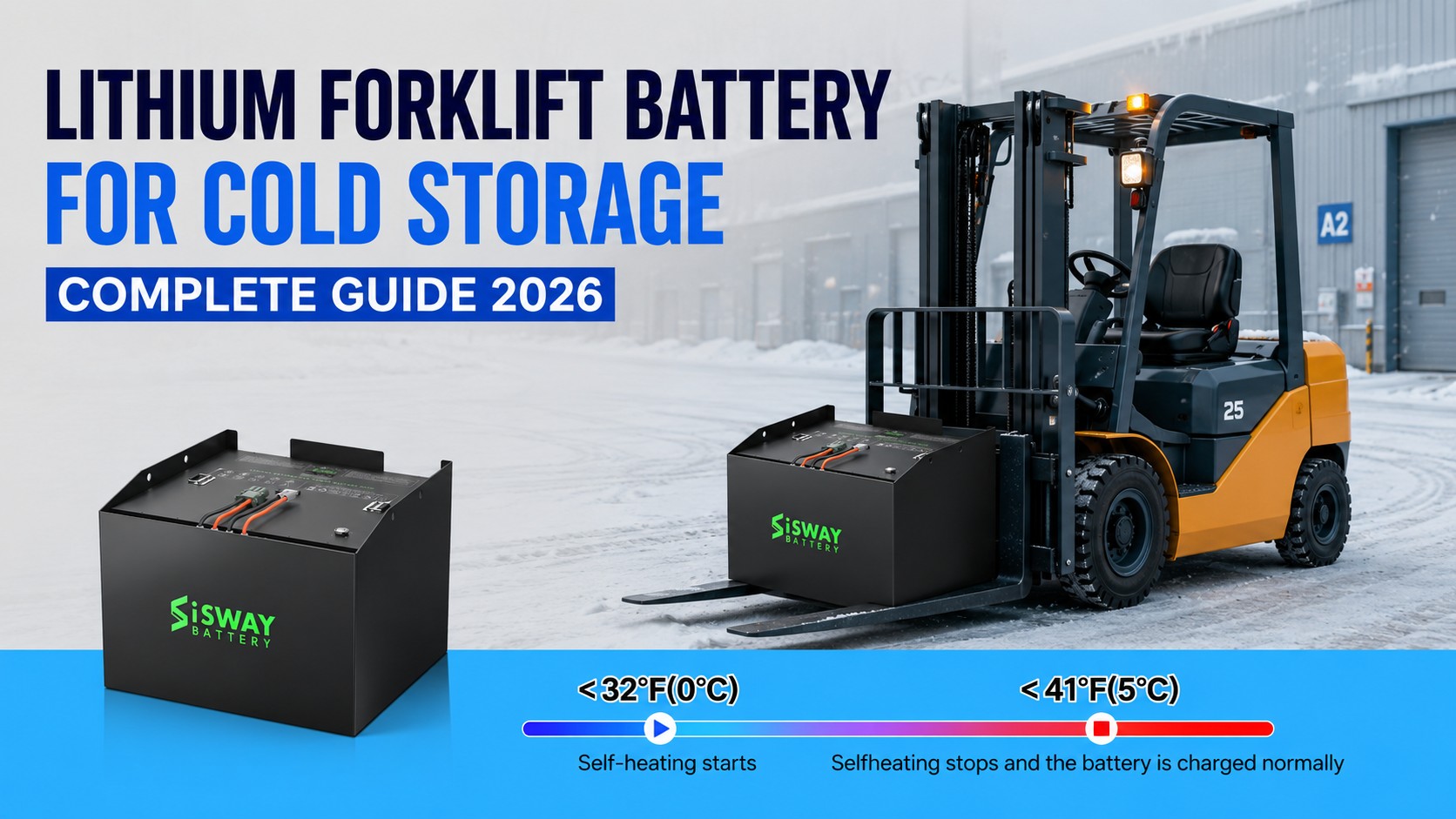
Built-in heating elements activate automatically below −10°C, warming cells to a safe charging range — all inside the freezer, with no battery removal needed.
IP67-Sealed Enclosure
Full protection against dust and water immersion eliminates condensation damage when batteries move between cold and ambient temperature zones.
Intelligent BMS
Real-time monitoring of cell temperature, charge state, and voltage balance. Prevents unsafe charging below 0°C and guards against overcharge and short circuits.
Key insight: A 50-forklift warehouse switching from lead-acid to lithium forklift batteries cuts monthly downtime from 250 hours to just 30 hours — an 88% reduction — while eliminating over $40,000 in annual maintenance labor costs.
Lead-Acid vs. Lithium Forklift Battery: Cold Storage Head-to-Head
The data below shows why cold storage operators worldwide are choosing lithium forklift batteries from Sisway Battery as the standard for their freezer fleets.
| Specification | LiFePO4 Lithium | Lead-Acid |
|---|---|---|
| Capacity at −20°C | ✓ 80–95% of rated | ✗ 40–50% of rated |
| Charges inside freezer | ✓ Yes — BMS active heating | ✗ No — heated room required |
| Charge time | ✓ 1–2 hrs (fast charge) | ✗ 8+ hrs + cool-down period |
| Batteries needed per truck | ✓ 1 battery is sufficient | ✗ 2–3 batteries per truck |
| Cycle life (cold storage) | ✓ 3,000–4,500+ cycles | ✗ 500–1,000 cycles |
| Maintenance required | ✓ Zero — maintenance-free | ✗ Weekly watering & equalization |
| Service life in cold storage | ✓ 5–10 years | ✗ 1.5–3 years |
| Safety (gas / acid risk) | ✓ Fully sealed — zero risk | ✗ Hydrogen gas + acid spills |
6 Critical Specifications to Check Before Buying
Not every lithium forklift battery is built for freezer environments. Before purchasing, verify each of these specifications to ensure the battery will actually perform in your cold storage operation.
- Operating temperature range: Discharge rated to at least −20°C with active heating that enables safe charging at those same temperatures.
- IP rating: IP67 minimum for any freezer environment — confirms full sealed protection against condensation damage and moisture ingress.
- Cycle life at cold temperature: Life-cycle claims must be validated at operating temperature — not just at 25°C. Look for verified 3,000+ cold cycles.
- Safety certifications: UL2580, CE, and IEC62619 confirm independent safety testing — often mandatory for industrial insurance compliance.
- Heating system type: Active electric cell heating outperforms passive insulation, especially during long idle periods inside a deep-freeze environment.
- Voltage compatibility: Always match battery voltage exactly to your equipment specification — incorrect voltage damages the forklift and voids warranty.
Choose the Right Voltage for Your Cold Storage Equipment
Sisway Battery manufactures lithium forklift batteries in five voltage configurations, each matched to specific cold storage equipment types. Select your voltage below to explore the full product range.
Opportunity Charging: The Cold Storage Productivity Multiplier
One of the biggest practical advantages of lithium forklift batteries in freezer operations is opportunity charging — the ability to recharge during any available break, without waiting for a full discharge cycle first.
Lead-acid batteries cannot do this. They require complete charge cycles followed by a mandatory cool-down period, all outside the freezer. A lithium battery with a smart BMS accepts partial charges at any time with no memory effect and no reduction in cycle life.
In practice, a forklift can plug in during a 20–30 minute shift break — inside the cold zone — and return to full power immediately. No swap. No heated battery room. No lost shift time. For 24/7 multi-shift operations, a single lithium battery per truck is typically sufficient to cover around-the-clock operations, eliminating the entire cost of spare battery sets.
Ready to Power Your Cold Storage Fleet?
Browse Sisway’s complete range of lithium forklift batteries — 24V to 80V, built for industrial cold storage — or contact our team for a custom OEM/ODM solution for your operation.
View All Forklift BatteriesFinal Thoughts
Cold storage is one of the harshest environments any forklift battery has to endure. Lead-acid chemistry — however familiar — was not designed for it. Repeated sub-zero exposure shortens its life, degrades performance across every shift, and creates compounding operational costs that add up to hundreds of thousands of dollars over a fleet’s lifetime.
LiFePO4 lithium forklift batteries solve every one of those problems: stable capacity at extreme cold, in-freezer charging via active heating, zero maintenance, and a service life 3 to 5 times longer than lead-acid under equivalent cold storage conditions. With payback periods typically under 36 months and monthly downtime reductions of up to 88%, the total cost of ownership case is clear.
Explore the full Sisway lithium forklift battery range to find the right voltage and capacity for your equipment — or contact the Sisway team to discuss a custom solution built around your specific cold chain requirements.