
Table of Contents
Introduction
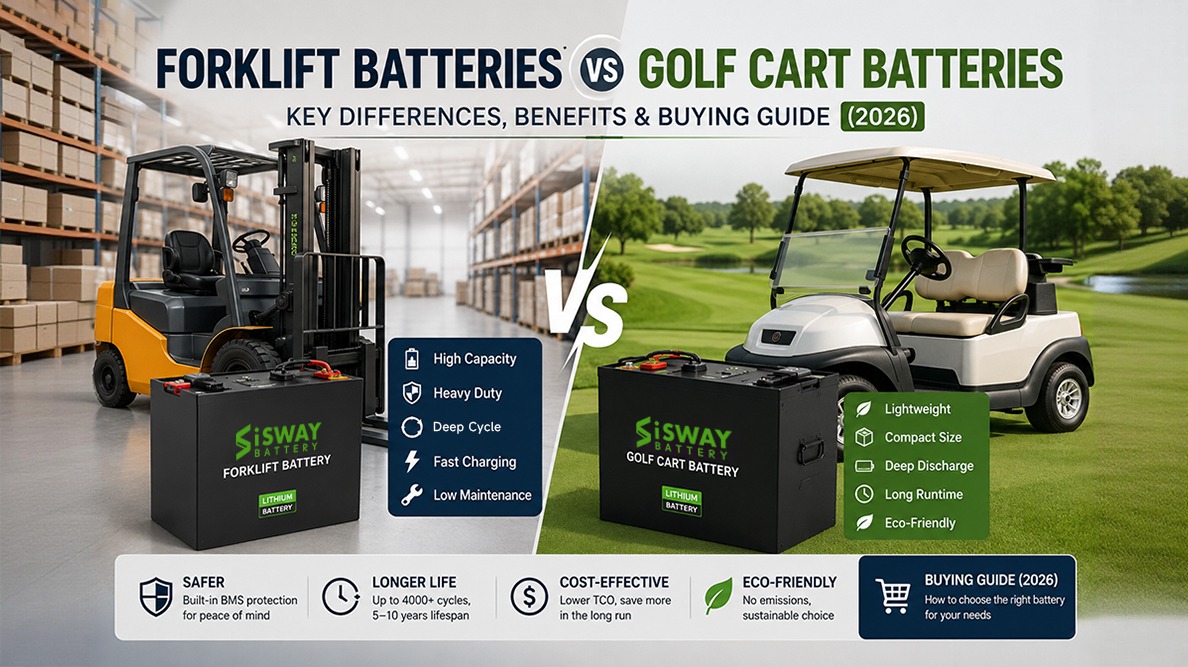
If you’ve ever searched for forklift batteries and golf cart batteries in the same breath, you’re not alone. Both are traction batteries designed to power electric vehicles, yet they serve vastly different worlds — one drives heavy industrial forklifts across warehouse floors at 48–80V, the other carries golfers across fairways at 36–48V.
Choosing the wrong battery can cost your operation thousands in downtime, premature replacements, and efficiency losses. In this comprehensive 2026 guide, Sisway Battery‘s engineering team walks you through every critical difference between forklift batteries and golf cart batteries — from voltage and capacity to lifespan, chemistry, maintenance, and where to buy the best units for your application.
Whether you manage a fleet of warehouse forklifts, operate a golf course, or you’re evaluating lithium vs. lead-acid options, this guide gives you the clarity to make a confident, cost-effective decision.
What Are Forklift Batteries?
Forklift batteries — also called motive power or traction batteries — are high-capacity energy storage units specifically engineered to power electric forklifts, reach trucks, order pickers, and other industrial material-handling equipment. They deliver sustained, high-amperage output over full 8–12 hour shifts, which is why industrial operations worldwide depend on them.
Key Characteristics of Forklift Batteries
- Voltage Range: Typically 24V, 36V, 48V, 72V, and 80V to match heavy-duty industrial equipment demands.
- Capacity: 200 Ah to 1,000+ Ah — enough energy to run forklifts through full multi-ton lifting cycles all day.
- Weight: Often engineered to be heavy (300–1,500 kg for lead-acid) because battery weight provides counterbalance stability for the forklift.
- Chemistry: Traditionally flooded lead-acid (FLA); increasingly LiFePO4 lithium-ion for superior performance.
- Charging: Fast opportunity charging and multi-shift capability with lithium variants; single full charge cycles for lead-acid.
- Safety: Built with industrial-grade BMS (Battery Management Systems), spill containment, and heavy-duty connectors.
Key Insight: Forklift batteries are purpose-built for extreme duty cycles. A single unit may perform 1,500–3,000+ charge cycles over its lifetime, powering millions of lift operations across 5–10 years of continuous industrial use.
What Are Golf Cart Batteries?
Golf cart batteries power electric golf carts used on courses, resorts, campuses, gated communities, and increasingly as personal urban transport vehicles. Unlike forklift batteries, they’re designed for lighter loads, moderate range, and frequent shallow discharge-recharge patterns.
Key Characteristics of Golf Cart Batteries
- Voltage Range: Commonly 36V, 48V, 60V, 72V, and 96V for high-performance carts and multi-passenger vehicles.
- Capacity: 100 Ah to 400 Ah — matched to the power needs of a 4–8 passenger cart covering 18–36 holes per charge.
- Weight: Golf cart batteries are designed to be as light as possible; lithium units can weigh 50–70% less than lead-acid equivalents.
- Chemistry: Traditional deep-cycle lead-acid (6V/8V/12V cells in series); rapidly transitioning to LiFePO4 lithium for weight savings and longevity.
- Charging: Standard overnight charge; lithium variants support faster 2–4 hour full recharge.
- Design: Compact, lower-profile packs to fit under cart seats or in designated battery compartments.
Did You Know? Modern LiFePO4 golf cart batteries from Sisway can cover 50–80 km per charge — enough for two full 18-hole rounds — while lasting 3–5x longer than conventional lead-acid packs.
Key Differences Between Forklift Batteries and Golf Cart Batteries
Understanding the differences between forklift batteries and golf cart batteries is essential for making the right purchasing decision. While both are classified as traction batteries, their design priorities are fundamentally different.
| Feature | Forklift Battery | Golf Cart Battery |
|---|---|---|
| Primary Use | Industrial material handling, warehouses | Golf courses, resort transport, personal use |
| Voltage Range | 24V – 80V | 36V – 96V |
| Typical Capacity | 200 – 1,000+ Ah | 100 – 400 Ah |
| Weight | Heavy (counterbalance role) | As light as possible (performance focus) |
| Discharge Rate | High continuous current (C/5 – C/3) | Moderate (C/10 – C/5) |
| Cycle Life (Li) | 3,000 – 5,000+ cycles | 2,000 – 4,000 cycles |
| Cycle Life (LA) | 1,000 – 1,500 cycles | 500 – 1,200 cycles |
| Charging Speed | Fast opportunity charging | Overnight or 2-4hr fast charge (Li) |
| Build Standard | Industrial-grade, rugged connectors | Compact, cart-fit design |
| BMS Complexity | Advanced multi-cell BMS | Standard BMS, sufficient for application |
| Interchangeable? | No — application-specific | No — application-specific |
Important: Forklift batteries and golf cart batteries are NOT interchangeable. Using a golf cart battery in a forklift (or vice versa) risks equipment damage, safety hazards, and voided warranties. Always match batteries to their intended application.
Battery Capacity and Performance Comparison
Capacity and performance are where forklift batteries and golf cart batteries diverge most dramatically. A forklift handling 2–5 ton loads across 10-hour shifts demands a fundamentally different power profile than a golf cart carrying 2–4 passengers over 18 holes.
Forklift Battery Performance Metrics
- Energy Output: 48V × 600 Ah = 28.8 kWh — enough to power a 3-ton forklift for a full 8-hour shift of intensive operations.
- Peak Current: 300–800A during heavy lift operations, requiring batteries with ultra-low internal resistance.
- Depth of Discharge: Lead-acid forklifts optimally discharge to 80% DoD; lithium can safely reach 95–100% DoD.
- Shift Performance: Single-shift (8hr), multi-shift with opportunity charging (lithium), or battery swap programs (lead-acid).
Golf Cart Battery Performance Metrics
- Energy Output: 48V × 150 Ah = 7.2 kWh — ample for 35–55 km of golf course coverage per charge.
- Peak Current: 50–200A during hill climbing or acceleration; far less demanding than forklift duty cycles.
- Depth of Discharge: Lead-acid golf cart batteries optimally discharge to 50% DoD; lithium extends to 80–90% usable capacity.
- Range Per Charge: Lead-acid averages 25–35 km; LiFePO4 lithium provides 50–80 km per charge.
| Performance Factor | Forklift Battery (Li) | Golf Cart Battery (Li) |
|---|---|---|
| Typical Energy | 15 – 60 kWh | 5 – 15 kWh |
| Peak Discharge Current | 300 – 800A | 50 – 200A |
| Usable Capacity (Li) | 95% | 90% |
| Temp Performance | -20°C to 55°C | -20°C to 55°C |
| Self-Discharge / Month | <3% | <3% |
| Charge Efficiency | 97–99% (Li) | 97–99% (Li) |
Need Help Choosing the Right Battery?
Sisway Battery’s engineers are ready to recommend the ideal forklift or golf cart battery for your exact specifications and budget.
Lifespan and Maintenance Guide
Lifespan directly affects your total cost of ownership. Whether you’re evaluating forklift batteries and golf cart batteries, understanding how chemistry, usage, and maintenance interact with battery longevity is critical to making a smart investment.
Forklift Battery Lifespan
- ✓ Lead-Acid: 5–7 years / 1,000–1,500 cycles
- ✓ Lithium LiFePO4: 8–12 years / 3,000–5,000 cycles
- ✓ Requires monthly equalization (lead-acid)
- ✓ Water topping every 5–10 charge cycles (FLA)
- ✗ Lead-acid sensitive to improper charging
- ✗ Opportunity charging degrades lead-acid faster
Golf Cart Battery Lifespan
- ✓ Lead-Acid: 2–5 years / 500–1,200 cycles
- ✓ Lithium LiFePO4: 8–10 years / 2,000–4,000 cycles
- ✓ Zero maintenance with lithium chemistry
- ✓ Store at 50% SOC for seasonal use
- ✗ Deep discharges below 20% damage lead-acid
- ✗ Lead-acid loses 30–50% capacity in cold weather
Maintenance Best Practices for Both Battery Types
- Keep terminals clean: Corrosion on battery terminals increases resistance and can reduce capacity by 15–25%. Clean monthly with a baking soda solution.
- Avoid partial charging (lead-acid): Always fully charge lead-acid batteries before storage. Partial charges cause sulfation, permanently reducing capacity.
- Monitor State of Charge: Never discharge lead-acid below 20% SOC. Lithium (LiFePO4) has built-in BMS protection but good habits extend life further.
- Store properly: Store batteries in a cool, dry location (10–25°C). Avoid prolonged exposure to temperatures above 45°C or below -10°C.
- Use compatible chargers: Always use chargers matched to your battery chemistry and voltage. Mismatched chargers are the #1 cause of premature battery failure.
Lithium vs Lead-Acid Batteries: Which Wins in 2026?
For both forklift batteries and golf cart batteries, the industry has shifted decisively toward lithium iron phosphate (LiFePO4) technology in 2026. While lead-acid still offers a lower upfront cost, lithium’s total cost of ownership advantage over 5–10 years is overwhelming. Sisway Battery offers industry-leading industrial lithium battery solutions for both applications.
| Comparison Factor | LiFePO4 Lithium | Lead-Acid (FLA/AGM) |
|---|---|---|
| Cycle Life | 2,000–5,000+ cycles | 500–1,500 cycles |
| Energy Density | 120–160 Wh/kg | 30–50 Wh/kg |
| Weight (same capacity) | 50–70% lighter | Baseline |
| Charge Efficiency | 97–99% | 70–85% |
| Charge Time | 1–4 hours | 8–12 hours |
| Maintenance | Zero maintenance | Monthly watering + equalization |
| Operating Temp Range | -20°C to 55°C | 0°C to 40°C (optimal) |
| Self-Discharge | <3% per month | 5–15% per month |
| Upfront Cost | 2–3× higher | Lower initial cost |
| 5-Year Total Cost | 30–50% cheaper | Multiple replacements needed |
| Environmental Impact | Lower lifetime impact | Lead disposal required |
| BMS Protection | Built-in advanced BMS | No active protection |
2026 Verdict: For any operation running equipment more than 2–3 years, LiFePO4 lithium batteries deliver superior ROI for both forklift and golf cart applications. The break-even vs. lead-acid is typically reached in 18–30 months of regular use.
Which Battery Is Better for Industrial Use?
For industrial applications — warehouses, distribution centers, cold storage facilities, manufacturing plants, and port operations — forklift lithium batteries are unequivocally the right choice. Here’s why they outperform everything else in demanding industrial environments:
Why Forklift Lithium Batteries Dominate Industry
- Multi-Shift Capability: Lithium forklift batteries support opportunity charging — plug in during breaks, lunches, and shift changes to maintain 100% operational availability without battery swaps.
- Consistent Power Delivery: Unlike lead-acid, which experiences voltage sag as it discharges, lithium batteries deliver flat voltage curves, meaning your forklift performs identically at 100% and 20% state of charge.
- Cold Storage Certified: Sisway’s lithium forklift batteries are engineered to operate efficiently in freezer warehouses down to -20°C, where lead-acid loses 40–60% capacity.
- ROI Through Efficiency: A 2-forklift operation switching from lead-acid to lithium eliminates the need for spare battery sets, battery rooms, watering systems, and dedicated charging personnel — saving $15,000–$40,000 annually.
- Safety Compliance: No hydrogen gas emissions during charging, no acid spills, no heavy-metal contamination risks — essential for food-grade and pharma warehousing.
Which Battery Is Better for Golf Carts?
For golf cart applications — whether on championship courses, resorts, gated communities, campus transport, or leisure use — lithium golf cart batteries have become the gold standard in 2026. The performance advantages over traditional lead-acid packs are simply too significant to ignore.
Top Reasons to Switch to Lithium Golf Cart Batteries
- Weight Savings: A 48V 100Ah lithium pack weighs 13–18 kg vs. 60–70 kg for an equivalent lead-acid bank — dramatically improving cart performance, hill climbing, and range.
- Extended Range: Lithium delivers 50–80 km per charge vs. 25–35 km for lead-acid, covering multiple rounds without anxiety about running out of power.
- Zero Watering / Zero Maintenance: Course operators and private cart owners save hundreds of hours per year by eliminating water-topping, terminal cleaning, and equalization charging routines.
- Faster Charging: Charge a lithium golf cart battery fully in 2–4 hours vs. 8–12 hours for lead-acid — invaluable for high-turnover rental fleets.
- Consistent Performance: Lithium maintains full speed and torque until the battery is nearly empty — lead-acid carts noticeably slow down as battery depletes past 50%.
- Seasonal Storage Ready: Store lithium batteries all winter at 50% SOC with zero capacity loss — lead-acid requires full charge maintenance and still sulfates if unused.
Buying Guide for Forklift Batteries and Golf Cart Batteries (2026)
Ready to purchase? Follow these proven steps to select the right forklift batteries and golf cart batteries for your specific needs, avoid costly mistakes, and maximize your investment’s return.
Confirm Your Voltage and Capacity Requirements
Check your equipment’s battery compartment specs or OEM manual. For forklifts, note the rated voltage (24V/36V/48V/72V/80V) and minimum Ah capacity. For golf carts, confirm voltage (36V/48V/60V/72V) and the number of holes or km range you need per charge.
Choose Your Chemistry: Lithium or Lead-Acid
For new purchases in 2026, we strongly recommend LiFePO4 lithium for both applications. Calculate your 5-year TCO: lithium’s higher upfront cost is offset by 3–5× longer lifespan, zero maintenance, and higher efficiency. Sisway Battery is a trusted lithium battery manufacturer with proven industrial and golf cart solutions worldwide.
Verify Physical Dimensions and Weight Specifications
Battery compartments have exact size limits. For forklifts, also confirm the minimum weight requirement — some counterbalance forklifts require batteries above a minimum weight for safe operation. For golf carts, lighter is better, but confirm the tray dimensions and connector type (SB50, Anderson SB175, or proprietary).
Evaluate BMS Quality and Safety Certifications
Insist on batteries with a proven Battery Management System that protects against overcharge, over-discharge, short circuit, and thermal runaway. Look for certifications: UN38.3, CE, UL, IEC 62133. Sisway batteries include advanced BMS as standard on all lithium units.
Check Warranty, Support, and Manufacturer Reputation
A quality forklift lithium battery should carry a 3–5 year warranty; golf cart batteries typically offer 2–3 years. Verify the manufacturer provides technical support, replacement parts, and has documented case studies from similar customers.
Confirm Charger Compatibility Before Ordering
Your existing charger may not be compatible with a new lithium battery (lead-acid chargers use different charge algorithms). Either confirm your charger supports lithium profiles or budget for a compatible lithium charger. Sisway offers matched charger bundles for both forklift and golf cart applications.
Get a Custom Battery Quote from Sisway
Share your equipment model, voltage, and daily usage hours — our team will recommend the exact battery specification and provide a competitive quote within 24 hours.
Common Mistakes to Avoid When Buying Batteries
After serving thousands of industrial and recreational customers, Sisway Battery‘s team has identified the most costly mistakes buyers make when choosing forklift batteries and golf cart batteries. Avoid these pitfalls:
Buying by Price Alone (Cheapest Isn’t Cheapest)
An unbranded forklift battery at 40% below market price may use recycled cells, substandard BMS, and no real warranty. When it fails in 12–18 months (vs. the claimed 5 years), your total cost is 2–3× what a quality battery would have cost.
Using Lead-Acid Chargers on Lithium Batteries
Lead-acid chargers apply equalization voltage spikes that can permanently damage lithium cells or trigger BMS shutdowns. Always use a lithium-compatible charger matched to your battery’s voltage profile.
Ignoring Depth of Discharge Guidelines
Regularly discharging lead-acid forklift batteries below 20% SOC halves their service life. Even with lithium batteries, running below 10% SOC before recharging creates unnecessary stress on cells.
Mixing Old and New Batteries in Series/Parallel
In multi-cell lead-acid golf cart setups, adding one new 6V battery to a set of 2-year-old batteries causes the new battery to overwork and fail prematurely. Replace entire battery banks simultaneously.
Skipping Compatibility Verification for Forklifts
Some forklift models (especially reach trucks and order pickers) have software that detects battery type and voltage. Installing an incompatible battery may trigger error codes, disable the forklift, or void your equipment warranty.
Long-Term Storage Without Proper SOC
Storing lead-acid batteries discharged causes permanent sulfation. Storing lithium batteries at 100% SOC for months degrades cathode materials. Store at 40–60% SOC for optimal seasonal storage.
Conclusion: Making the Right Battery Choice in 2026
The landscape for forklift batteries and golf cart batteries has transformed dramatically. LiFePO4 lithium technology has matured into the clear performance and value leader for both applications — offering longer life, zero maintenance, superior efficiency, and compelling total cost of ownership.
For industrial operations, Sisway forklift lithium batteries eliminate multi-shift battery logistics, cold-storage performance limitations, and the ongoing cost of lead-acid maintenance. For golf courses, resorts, and individual cart owners, lithium golf cart batteries deliver range, weight savings, and reliability that lead-acid simply cannot match.
The choice between forklift and golf cart batteries should always start with the application — they are purpose-engineered products, not interchangeable commodities. Match your battery to your equipment, your duty cycle, and your operating environment — and choose a lithium battery manufacturer with the certifications, warranty, and track record to back their product.
Frequently Asked Questions
No — this is a dangerous and costly mistake. Golf cart batteries are not engineered for the high continuous discharge currents, thermal demands, or physical requirements of forklift operations. Using a golf cart battery in a forklift risks overheating, rapid degradation, BMS failure, and potential safety hazards. Forklift batteries are also typically much heavier to serve as counterbalance weight — a safety function that golf cart batteries cannot replicate.
Sisway lithium forklift batteries (LiFePO4) typically deliver 3,000–5,000 charge cycles, which translates to 8–12 years of service in typical single-shift warehouse operations. In multi-shift operations with opportunity charging, expect 5–8 years. This compares to 5–7 years for quality lead-acid forklift batteries under ideal maintenance conditions.
The ideal voltage depends on your cart’s motor and controller specifications. Standard 2-passenger carts typically use 36V or 48V systems. High-performance carts, 4-6 passenger models, and lifted carts often benefit from 48V or 72V systems for better torque and hill-climbing. Always match the battery voltage to your cart’s existing electrical system — voltage mismatches can damage controllers and motors. Sisway offers lithium batteries from 36V to 96V for all golf cart types.
For most users, yes — the math strongly favors lithium over a 5-year period. A quality LiFePO4 golf cart battery costs 2–3× more upfront but lasts 3–5× longer, requires zero maintenance, weighs 60% less, and provides superior range and consistent performance. When you factor in lead-acid replacement costs (every 2–3 years), watering maintenance time, and reduced cart performance, lithium delivers better total value for most users who operate carts regularly throughout the season.