
Introduction
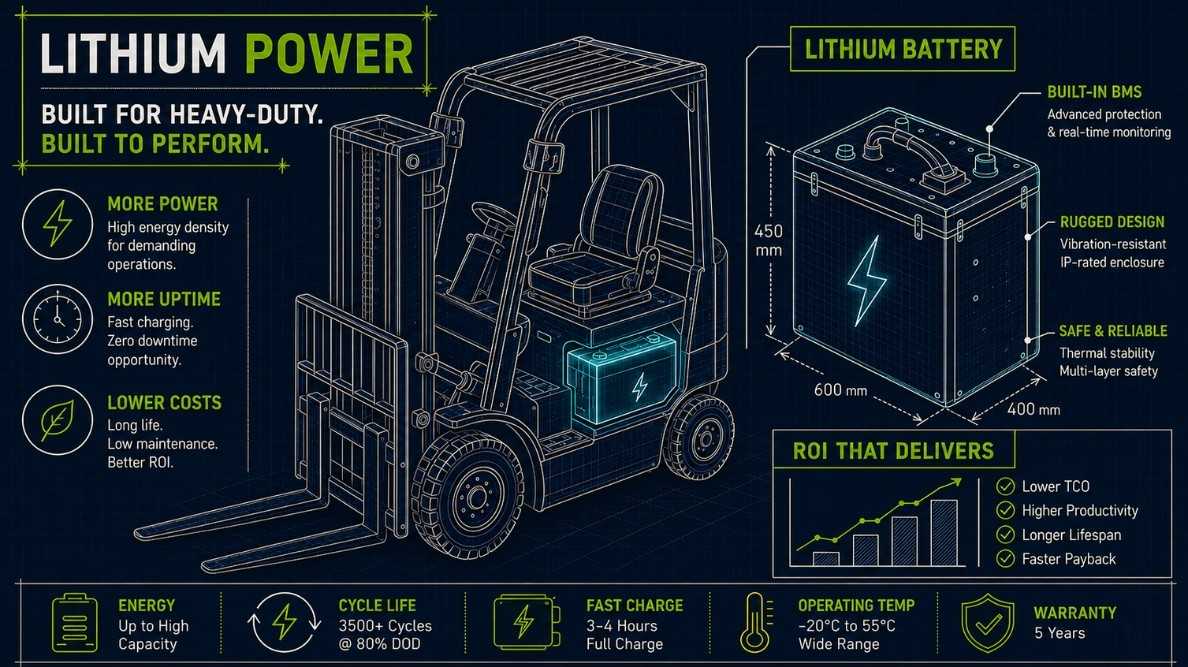
If you’re still running lead-acid in a multi-shift warehouse, you’re paying a premium you don’t have to. Here’s the spec-by-spec breakdown, the real TCO math, and a buying checklist procurement can act on today. Switching to LiFePO4 typically saves $20,000–$30,000 per forklift over 5 years.
3,000–6,000+
Cycles at 80% DoD
1–3 hrs
Fast-charge window
24V–80V
Voltage coverage
UL 2580
+ IEC 62619 certified
Quick answer: the best lithium batteries for forklifts are LiFePO4 packs with verified Grade A cells, proper voltage matching to your truck class, and a BMS that talks to your chargers. The rest of this guide walks through the specs, the supplier vetting, and the TCO math so you can build a facility-specific case.
Picking the best lithium batteries for heavy-duty forklifts isn’t complicated once you know which specs actually matter and which vendor pitches to tune out. One variable that determines how well those numbers pan out in practice: whether your supplier uses Grade A cells and offers genuine voltage customization rather than a one-size-fits-all catalog. That’s why serious procurement teams have started turning to manufacturers like Sisway Battery, which we cover specifically in the supplier section.
Why LFP Is the Chemistry That Holds Up
LFP vs. NMC: The Tradeoff That Matters in a Warehouse
NMC has higher energy density than LiFePO4, which matters when space or weight are genuinely limiting factors. In most standard forklift configurations, however, battery compartment dimensions are not a binding constraint — what these trucks need is a chemistry that survives deep cyclic duty, operates safely in an industrial environment, and doesn’t require constant attention. LFP delivers 3,000 to 6,000+ cycles at 80% depth of discharge. NMC delivers fewer total cycles and carries a higher thermal risk profile. In a warehouse running multiple shifts, that tradeoff is straightforward: LFP wins on every metric that actually matters for the application.
Voltage Ranges and What They Mean for Your Fleet
Forklift voltage tiers map to truck class and load rating. Matching pack voltage to the truck’s motor controller is non-negotiable — a mismatch doesn’t just underperform, it causes controller faults and can void equipment warranties.
OEM/ODM suppliers can configure packs to exact voltage specs rather than forcing a catalog fit, which matters when you’re standardizing across a mixed fleet.
Specs That Determine Shift Survival
Capacity (Ah), C-Rate, and How to Size the Right Pack
Start with your shift energy requirement, then work backward. A forklift drawing 15 kWh per shift on a 48V pack, operating at 80% usable depth of discharge with a 90% efficiency margin, needs approximately 434 Ah. Round up to the nearest standard pack size and add a 20 to 30% reserve for cold temperatures, peak acceleration loads, and battery aging over time.
| 48V packs | 300Ah–700Ah — covers Class I and II counterbalance and reach trucks |
| 72V packs | 400Ah–600Ah — for heavier counterbalance trucks |
| 80V packs | 400Ah–700Ah — for the heaviest-duty Class I equipment |
C-rate matters as much as capacity. Forklift acceleration peaks and hydraulic lift loads demand high instantaneous current. If your pack’s continuous discharge rating can’t handle those spikes without voltage sag, you’ll get sluggish performance and accelerated cell degradation. Verify the pack’s rated continuous and peak discharge C-rate against your truck’s actual peak current draw before committing to a configuration.
Cycle Life, BMS Protections, and Certifications Buyers Overlook
Cycle life is measured to 80% capacity retention, the point at which a pack is considered end-of-life for industrial purposes. For multi-shift operations, the benchmark is 4,000+ cycles at 80% DoD. LiFePO4 packs from reputable manufacturers regularly hit 3,000 to 5,000 cycles, compared to 200 to 600 cycles for lead-acid under the same conditions. That 5-to-10x advantage is the mathematical foundation of every TCO argument in this article.
The BMS is what protects that cycle life in practice. Require individual cell voltage and temperature monitoring, deep discharge and overcharge protection, and CAN communication with compatible chargers. State-of-charge display on the truck interface is a practical necessity for shift management. If your facility includes cold storage or hazmat zones, confirm any supplemental ratings with the supplier before purchase.
Suppliers Worth Putting on Your Shortlist
What Separates a Reliable Industrial Supplier from a Cheap One
Cell grade is the variable that most procurement teams underweight. Grade A cells have tighter capacity tolerances, lower internal resistance variation, and better cycle life retention than B-grade alternatives. The difference shows up gradually through capacity fade and warranty claims, not on the spec sheet at purchase. In the North American market, Green Cubes, Flux Power, and EnerSys serve established industrial segments. BYD lists a 10-year warranty on paper, though buyers should verify the specific conditions, cycle-count caps, and pro-rated terms attached to it before treating that figure as a direct comparison. For procurement teams sourcing OEM-configured or private-label packs at volume, certified Chinese manufacturers with proven export logistics have become a cost-competitive alternative to Western-branded products.
Why Sisway Battery Earns a Spot on That Shortlist
Sisway Battery, operated by Shenzhen Shiwei New Energy Co., Ltd., builds LiFePO4 packs using Grade A cells across a 24V to 96V voltage range with full OEM/ODM customization for form factor, voltage, and capacity.
Backed by 10-year technical support. For fleet operators or distributors who need volume, verified cell quality, and voltage flexibility without paying a North American distributor markup on every unit, Sisway belongs on the shortlist — request a spec sheet and sample quote to validate the details for your specific configuration.
TCO: Lithium vs. Lead-Acid Over 5 and 10 Years
What the 5-Year Numbers Actually Look Like
In a multi-shift heavy-duty warehouse, the 5-year cost breakdown per truck is not close.
The savings range from $20,000 to $30,000 per truck, and that’s before factoring in reduced unplanned downtime.
Why the 10-Year Gap Widens Further
Lead-acid batteries in heavy-duty use typically need full replacement every three to five years. Over a 10-year horizon, that means at least one additional purchase plus disposal costs per truck. A well-maintained LiFePO4 pack from a Grade A cell supplier can run five to ten years, often avoiding the mid-life replacement cycle entirely. The 10-year TCO advantage for lithium in high-utilization warehouses regularly exceeds 40%. To build a facility-specific calculation, start with your shift energy draw, your current battery count per truck, your actual watering and maintenance labor hours, your electricity rate, and your replacement schedule. The inputs vary by operation, but the direction of the math does not.
Charging Infrastructure: What Your Floor Actually Needs
Charger Types, Power Ratings, and Electrical Specs
Industrial lithium fleets use two primary charging modes. Opportunity charging runs at 0.21 to 0.30C, pulling top-ups during breaks and shift changes. Fast charging runs at 0.31 to 0.60C where the battery manufacturer supports it, reducing the window needed to meaningfully recharge a pack. Standard electrical installation for industrial fast chargers uses 480V 3-phase circuits with breakers sized to the charger’s AC input current. For a 48V/600Ah setup, that typically means 100A breakers and 8 AWG copper feeder conductors. BMS-to-charger communication via CAN protocol is a requirement, not a nice-to-have. Mismatched charger-battery pairs are a common and expensive mistake that causes premature cell degradation and voids warranties.
Ventilation, Placement, and Grid Load Considerations
LiFePO4 packs don’t off-gas like lead-acid, so vented charging rooms and watering stations can be eliminated from the floor plan. High-rate charging still generates thermal load at the charger itself, so adequate airflow around charger units is required. When multiple fast chargers run simultaneously, load-sharing controls prevent demand spikes that hit your facility’s peak-demand billing. Charger placement strategy matters operationally: units positioned near active work zones allow opportunity charging during natural break periods, keeping trucks on the floor instead of pulling them off productive duty for extended battery swaps.
Your Buying Checklist & a Case Study
8-Point Checklist for Buying the Best Lithium Forklift Batteries
Case Study: 12 Trucks, Two Shifts, One Clear Outcome
A distribution center running 12 48V forklifts on two shifts switched from lead-acid to LiFePO4 packs configured at 400Ah with Grade A cells and OEM voltage matching. Before: three battery sets per truck, daily watering routines, weekly maintenance labor, and regular unplanned downtime from failing cells and missed watering cycles. After: one pack per truck, opportunity charging during break periods, near-zero battery maintenance labor.
$336,000+
recovered across 12 trucks over five years — over $28,000 per truck — from a single infrastructure decision
The outcome depends directly on proper Ah sizing, BMS-to-charger compatibility, and sourcing Grade A cells from a supplier with verifiable cell quality and OEM configuration capability.
The Decision Path, Simplified
The best lithium batteries for heavy-duty warehouse operations aren’t the ones with the longest spec sheet. They’re the ones with the right voltage configuration for your truck class, verified Grade A cells, a BMS that communicates with your chargers, and a supplier who stands behind the product with real warranty terms and documented cell traceability. That’s what separates the best lithium batteries for forklifts from the catalog filler that looks similar on paper.
Size your Ah from your actual shift energy requirement and match your charging infrastructure to the pack’s supported C-rate and BMS protocol. Run the TCO math with your own shift data and labor costs, then shortlist suppliers who can demonstrate Grade A cells and genuine OEM customization. Procurement teams that move through that process systematically don’t get surprised by post-purchase performance gaps.
Warehouses that make this transition now build an operational cost advantage that compounds as energy and labor costs rise. Every shift cycle costs less, every maintenance hour is recovered, and the battery was built for exactly this kind of punishment. The lead-acid math is done. The only question is how quickly your operation captures the savings.
Ready to size the right lithium pack for your fleet?
Request a Spec Sheet & Quote