
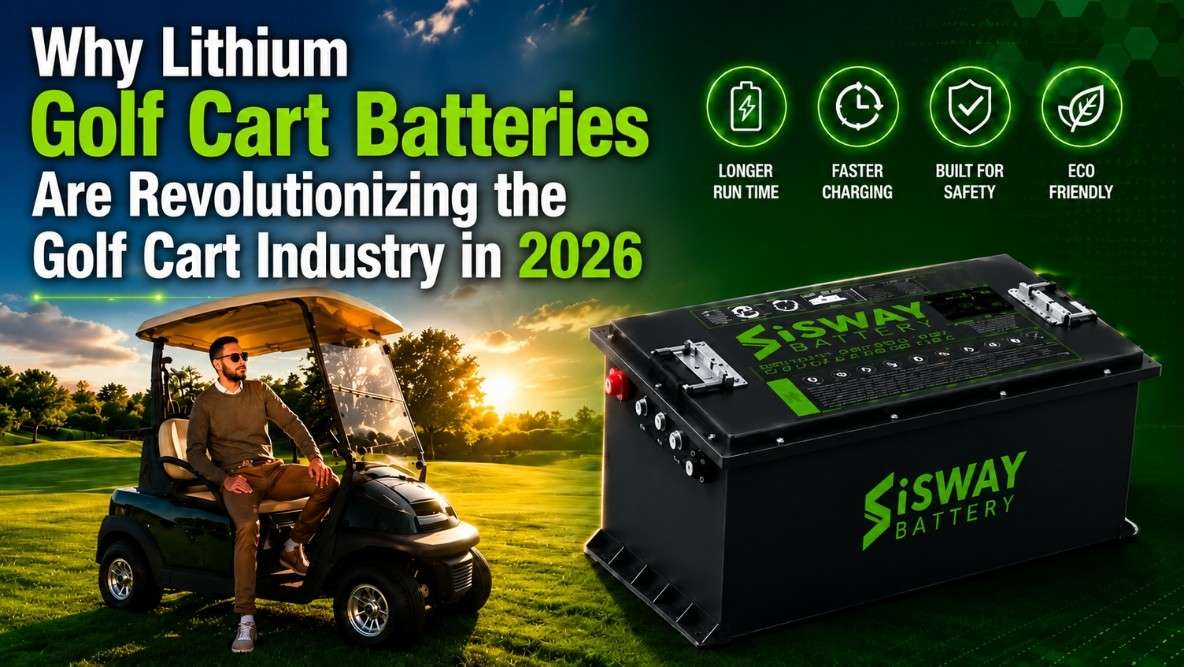
The golf cart industry is undergoing the biggest technology shift in its 70-year history. Lithium golf cart batteries — once a premium niche product — have crossed into the mainstream, changing how golf courses, resort fleets, industrial facilities, and everyday owners power their vehicles. In 2026, lithium is no longer the future. It’s the present.
This guide covers the science behind LiFePO4 chemistry, the real economics of switching, voltage systems for different applications, and the practical factors every buyer should weigh — whether you run a 200-cart fleet or are replacing one pack on a personal cart.
Why Lead-Acid Batteries Are Becoming Obsolete
Lead-acid isn’t bad technology — it’s predictable, recyclable, and cheap upfront. But on every metric that matters in 2026 — weight, maintenance, cycle life, and consistent power — it’s outclassed by lithium.
A standard 48V flooded lead-acid pack weighs 180–250 lbs, versus 60–80 lbs for an equivalent lithium pack — a 60–70% reduction. Lead-acid also demands watering every 4–6 weeks, terminal cleaning, and gravity checks; neglect causes sulfation and premature failure. A quality lead-acid battery delivers only 500–700 charge cycles versus 2,000–5,000 for LiFePO4, meaning lead-acid packs are typically replaced every 3–5 years while lithium can last 8–15 years.
Lead-acid also sags under load — a 48V pack at 50% charge delivers noticeably less power, so golfers feel sluggish acceleration late in a round. Lithium holds a flat voltage curve, delivering the same performance from full charge to near-empty.
Lead-acid batteries lose performance gradually, invisibly — until a fleet cart can’t make it up the 14th fairway. Lithium eliminates that category of failure entirely.
What Makes LiFePO4 Lithium Different
“Lithium battery” covers several chemistries. For golf carts, the right one is Lithium Iron Phosphate (LiFePO4). Unlike cobalt-based chemistries (LCO, NMC) used in phones and EVs, LiFePO4 trades a little energy density for dramatically better thermal stability, chemical stability, and cycle life — exactly what a daily-cycling traction battery needs.
LiFePO4 offers 2,000–5,000 cycle life, inherent thermal stability, non-toxic chemistry, and flat voltage output — without needing exotic thermal management. That makes it safe and practical for outdoor, year-round golf cart use.
- Energy density: 90–160 Wh/kg (vs 30–50 for lead-acid)
- Cycle life: 2,000–5,000 cycles at 80% depth of discharge
- Efficiency: 97–99% round-trip (vs 70–80% for lead-acid)
- Thermal runaway threshold: >270°C — far safer than other lithium chemistries
Key Benefits of Lithium Golf Cart Batteries
Longer Lifespan
2,000–5,000 cycles vs 500–700. One lithium pack can outlast 5+ lead-acid replacements.
Faster Charging
Full charge in 2–4 hours vs 8–12 hours, enabling true opportunity charging.
Zero Maintenance
No watering, no terminal cleaning, no acid checks — fully sealed by design.
Weight Reduction
Up to 70% lighter, improving range, handling, and tire wear.
Consistent Power
Flat discharge curve means the same acceleration and hill-climbing from full to near-empty.
Superior Safety
Thermally stable, non-toxic chemistry with multi-layer BMS protection.
For a 50-cart fleet, eliminating watering, terminal cleaning, and related service calls removes roughly 135 hours of technician time a year — about $4,050 in labor alone, not counting parts or premature failures.
Explore Sisway’s Lithium Golf Cart Battery Range
Browse our complete selection of LiFePO4 golf cart batteries built for performance, longevity, and zero maintenance.
View Golf Cart Batteries →BMS and Safety
Every quality lithium golf cart battery relies on a Battery Management System (BMS) — the electronic brain that monitors cell voltages, balances charge across cells, manages temperature, and protects against overcharge, over-discharge, and short circuits. Premium packs add Bluetooth monitoring, letting owners or fleet managers check state of charge, range, and battery health from a phone.
Safety concerns about lithium are usually based on cobalt chemistries (NMC, LCO), not LiFePO4. LiFePO4’s thermal runaway threshold exceeds 270°C — far beyond any realistic failure scenario in a golf cart — and it releases oxygen far more slowly under stress, making fire propagation extremely unlikely. Look for UN 38.3, UL 2580, and IEC 62133 certification when evaluating suppliers.
Lithium vs Lead-Acid: Full Comparison
| Feature | LiFePO4 Lithium | Flooded Lead-Acid |
|---|---|---|
| Energy Density | 90–160 Wh/kg | 30–50 Wh/kg |
| Cycle Life | 2,000–5,000 cycles | 500–700 cycles |
| Maintenance | None required | Weekly watering |
| Charge Efficiency | 97–99% | 70–80% |
| Weight (48V pack) | 55–80 lbs | 180–250 lbs |
| Voltage Under Load | Flat curve — stable | Significant sag |
| Typical Lifespan | 8–15 years | 3–5 years |
| Full Charge Time | 2.5–4 hours | 8–12 hours |
| Environmental Hazard | Low (non-toxic) | High (lead, acid) |
Cost Analysis and Return on Investment
Lithium costs 1.5–3× more upfront than lead-acid, but the total-cost-of-ownership picture flips quickly once replacement cycles, labor, and efficiency are factored in.
| Cost Component (10 yrs, per cart) | LiFePO4 Lithium | Flooded Lead-Acid |
|---|---|---|
| Total Battery Cost | $900–$1,400 | $1,050–$1,800 |
| Maintenance Labor | ~$0 | $600–$1,200 |
| Estimated 10-Year Total | ~$1,050–$1,700 | ~$1,850–$3,200 |
- Lithium typically pays back its premium within 3–5 years via maintenance savings alone
- Avoided replacement adds $700–$1,400 more in savings over 10 years
- Fleets with 50+ carts can expect $40,000–$75,000 in cumulative 10-year savings
Voltage Options: 36V vs 48V vs 72V
Older carts on flat terrain, light loads, lower cost.
Industry standard. Best balance of performance, range, and availability.
High-performance and industrial use — max torque and payload.
For most residential and golf course use, a 48V lithium system offers the best mix of performance, range, and cost. 72V suits performance or heavy commercial applications; 36V suits older carts on flat terrain.
How to Choose the Right Golf Cart Battery
- Confirm your voltage: 36V, 48V, or 72V — check the battery compartment or motor controller label.
- Match your range needs: a 48V/30Ah pack gives ~20–25 miles; a 50Ah pack extends to 35–45 miles. Add 20–30% for hills or heavy loads.
- Check BMS quality: overcharge/over-discharge protection, active cell balancing, and temperature management separate a 5-year battery from a 12-year one.
- Verify certifications: UN 38.3 transport certification and a 2+ year warranty are minimum bars for a reputable supplier.
- Confirm physical fit: drop-in lithium packs should match your existing lead-acid tray dimensions and terminal layout.
Common mistakes: using a lead-acid charger on a lithium pack (the charging algorithms are incompatible), underestimating capacity needs, and prioritizing price over BMS quality.
Charging and Storage Tips
- Always use a charger rated specifically for LiFePO4 at the correct voltage.
- Charge after each use — partial charging causes no damage, unlike with lead-acid.
- Avoid charging below 0°C (32°F); most BMS units block this automatically.
- For off-season storage, keep the battery at 40–60% charge in a cool, dry place, and check every 3 months.
A quality LiFePO4 battery delivers 2,000–5,000 cycles before falling to 80% capacity — typically 8 to 15 years of daily seasonal use, versus 3–5 years for lead-acid.
Why Choose Sisway Battery
Battery quality differences that are invisible at purchase become very visible by year 5 or 10. Sisway Battery is built around batteries that genuinely last their full rated lifetime, not just under lab conditions.
Grade A LiFePO4 Cells
Only top-tier prismatic cells — no B-grade or refurbished stock.
Advanced BMS Protection
Active cell balancing, temperature protection, and optional Bluetooth monitoring.
Drop-In Compatibility
Direct replacements for standard lead-acid trays — no fabrication required.
Reliable Support
Pre-sale technical guidance and post-purchase support from battery specialists.
Sisway’s Lithium Golf Cart Battery collection spans 36V, 48V, and 72V systems with multiple capacity options — from weekend residential carts to daily commercial fleets.
Ready to Upgrade to Lithium Golf Cart Power?
Explore our full range of LiFePO4 golf cart batteries — built for consistent performance and a decade or more of reliable service.
Shop LiFePO4 Golf Cart Batteries →Frequently Asked Questions
Are lithium golf cart batteries worth the investment?
Yes. Despite a higher upfront cost, 5× longer cycle life, zero maintenance, and faster charging typically make the 10-year total cost of ownership 30–50% lower than lead-acid.
Can I replace lead-acid batteries with lithium in my existing cart?
In most cases yes — drop-in lithium packs match standard tray dimensions. You’ll need matching voltage (36V/48V/72V) and a lithium-compatible charger, since lead-acid chargers use incompatible algorithms.
Do I need a special charger for a lithium battery?
Yes. Lead-acid chargers can overcharge lithium cells or damage the BMS. Always use a charger programmed specifically for LiFePO4 at the correct voltage.
Are lithium golf cart batteries safe?
LiFePO4 is among the safest lithium chemistries, with a thermal runaway threshold above 270°C. Combined with a quality BMS, it’s safer than lead-acid, which contains corrosive acid and toxic lead.
How do I know when my battery needs replacing?
Watch for capacity fade — if your range drops to 70–80% of original, the battery is nearing end of life. Bluetooth-enabled BMS units can report State of Health directly. This decline typically takes 8–15 years.
Conclusion: The Lithium Transition Is Now
The case for lithium golf cart batteries in 2026 isn’t about novelty — it’s economics. Lithium batteries last longer, cost less over time, need no maintenance, charge faster, and perform more consistently than the lead-acid technology they replace. The question isn’t whether to switch, but when.
Explore Sisway Battery’s complete range of LiFePO4 Golf Cart Batteries — built for performance, longevity, and zero-maintenance operation.