

Table of Contents
- Why Golf Cart Safety Matters for Families
- The Battery Is the Foundation of a Safe Family Golf Cart
- Lead-Acid vs Lithium: Which Battery Is Safer?
- Battery Safety Features Every Family Cart Should Have
- Passenger Safety Basics for Family Golf Carts
- Mirrors, Lighting, and Visibility Upgrades
- Speed Control for Family Use
- Preventing Golf Cart Rollovers and Accidents
- Street-Legal Requirements by State
- Charging Safety: Why Battery Choice Matters
- Routine Safety and Battery Maintenance Checklist
- Choosing the Right Battery Upgrade for Family Golf Cart Safety
- Conclusion
- Frequently Asked Questions
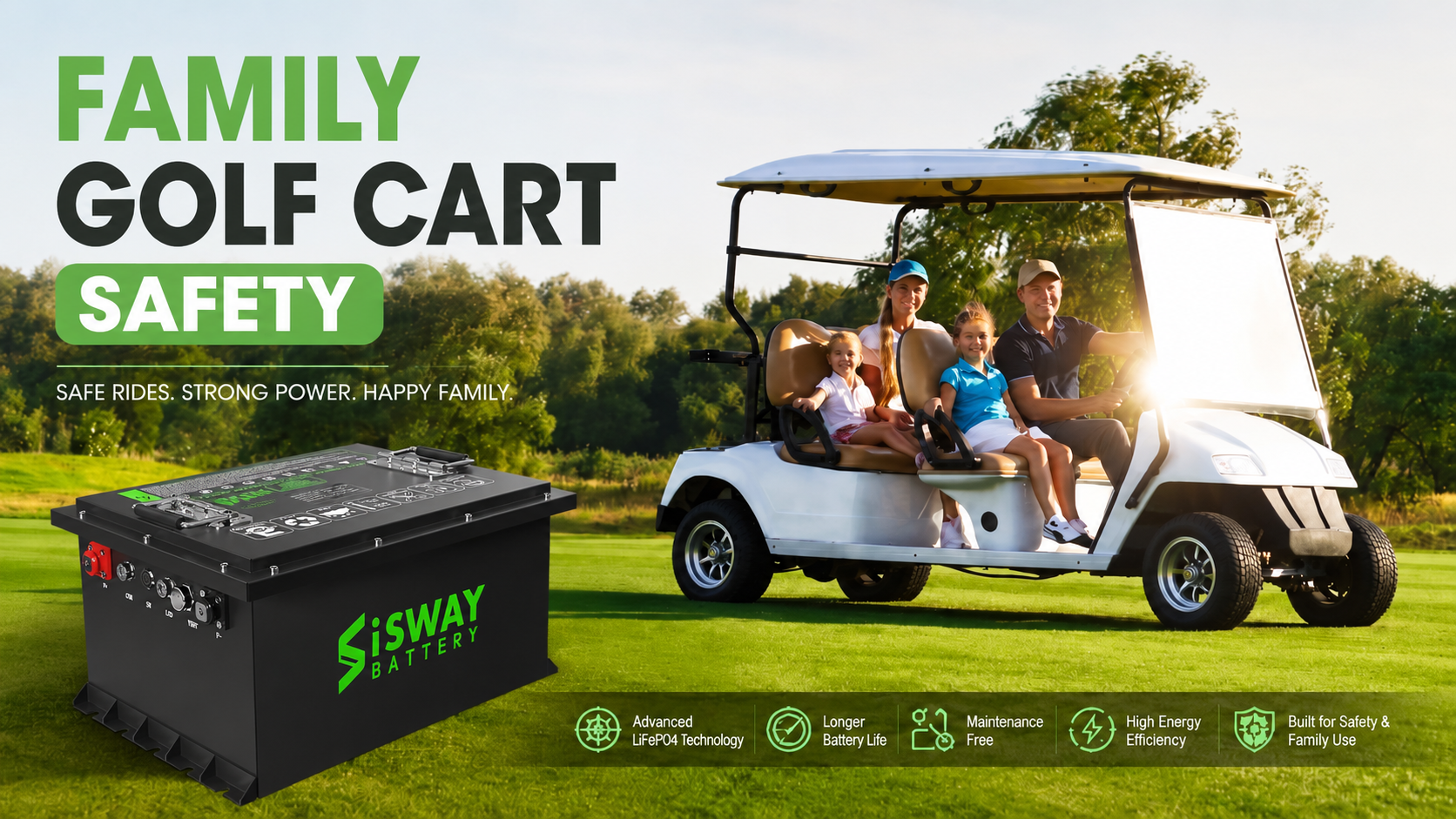
Family golf cart safety is about more than a slower speed setting — it’s the combination of driver habits, safety hardware, and a battery system that behaves predictably every time the cart is used. Between school pickups, neighborhood cruises, and weekend trips to the course, a family golf cart carries kids, groceries, and passengers of every age, and the battery powering it plays a bigger role in that safety picture than most owners realize. This guide walks through the practical steps behind real family golf cart safety, from passenger habits and visibility upgrades to the single decision that affects nearly every other safety factor: the battery underneath the seat.
Why Family Golf Cart Safety Matters
Under Federal Motor Vehicle Safety Standard No. 500, the National Highway Traffic Safety Administration classifies golf cars used on public roads as Low-Speed Vehicles, subject to a limited set of federal equipment rules rather than the full crashworthiness standards required of passenger cars. In practice, that means “low-speed” doesn’t mean low-risk: carts typically lack seat belts as standard equipment, have an open frame with no doors, and sit lower to the ground than a car — all factors that raise injury risk if something goes wrong. Add young children, pets, or groceries into the mix, and the margin for error shrinks further, which is exactly why family golf cart safety deserves a deliberate, whole-cart approach rather than a single fix.
Most incidents involving families are preventable. They come down to a mix of driver habits, missing safety hardware, and — increasingly overlooked — a battery system that doesn’t hold voltage steadily or protect itself the way it should. Addressing all three areas together is what actually delivers family golf cart safety for everyday use, not just occasional supervised rides.
The Battery Is the Foundation of a Safe Family Golf Cart
Before you invest in seat belts, lighting kits, or mirrors, it’s worth starting with the component that determines how consistently your cart behaves: the battery bank. A battery that sags under load, drops voltage unevenly, or requires constant maintenance introduces safety risk in ways that aren’t always obvious.
An underpowered or degrading battery can cause a cart to lose speed unpredictably on an incline, hesitate when pulling away from a stop, or leave a driver stranded farther from home than expected. None of that is a driver error — it’s a battery limitation. Families who upgrade to a 36V lithium golf cart battery generally notice this first: power delivery stays flat and predictable from a full charge down to a low one, instead of tapering off the way lead-acid does.
Lead-Acid vs Lithium: Which Battery Is Safer for Family Use?
Lead-acid has powered golf carts for decades, and it isn’t inherently unsafe when properly maintained. But “properly maintained” is doing a lot of work in that sentence — watering schedules, terminal corrosion, acid spill risk, and voltage sag are all real considerations for a battery bank a family relies on every week.
LiFePO4 (lithium iron phosphate) batteries, the chemistry used in Sisway’s golf cart lineup, are widely regarded as one of the most thermally stable lithium chemistries available, which is a major reason they’ve become the standard for golf cart and deep-cycle applications rather than the higher-energy-density chemistries found in consumer electronics.
| Safety Factor | Lead-Acid Battery | 36V Lithium (LiFePO4) |
|---|---|---|
| Maintenance required | Regular watering, terminal cleaning, equalization | None — fully sealed, maintenance-free |
| Acid/spill risk | Present — corrosive electrolyte | None — solid-state cell chemistry |
| Voltage under load | Drops steadily as charge depletes | Stays flat through most of the discharge curve |
| Overcharge/overdischarge protection | Manual monitoring needed | Automatic via integrated smart BMS |
| Weight in cart frame | Heavy, raises rollover-relevant center of gravity | About one-third the weight of an equivalent lead-acid bank |
| Thermal stability | Moderate | High — LiFePO4 is among the most stable lithium chemistries |
Battery Safety Features Every Family Cart Should Have
Not every lithium battery is built to the same standard, so it’s worth knowing what to actually look for when a battery is going to carry your kids around the neighborhood. These are the features that turn a battery upgrade into a genuine family golf cart safety improvement rather than just a performance one.
Integrated Smart BMS
Continuously monitors cell voltage, temperature, and current, cutting off charging or discharge automatically before conditions become unsafe.
Cell Balancing
Keeps individual cells aging evenly across the pack so capacity doesn’t degrade unevenly over years of family use.
Short-Circuit Protection
Automatically isolates the pack if a short is detected, rather than relying on a driver to notice a problem first.
Overtemperature Cutoff
Stops charge or discharge if temperatures move outside a safe range, an important safeguard for carts stored outdoors in summer heat.
Good to know: Sisway’s 36V lithium packs can also be configured with CAN bus, RS485, or Bluetooth monitoring protocols for fleet and OEM buyers who want live visibility into pack health across multiple carts.
Passenger Safety Basics for Family Golf Carts
Once the battery and power system are handled, the rest of family golf cart safety comes down to habits and hardware around passengers themselves.
Seat Belts: Non-Negotiable for Family Use
Most golf carts don’t come with seat belts installed, but they’re inexpensive to add and dramatically reduce ejection risk during a sudden stop or rough terrain. For family use, retrofitting every seating position is worth the modest cost.
Follow Proper Passenger Limits
- Never exceed the manufacturer’s rated passenger capacity
- Keep hands, arms, and feet inside the cart at all times
- No riding in the cargo bed or standing while the cart is moving
- Seat smaller children in the center or rear seats away from the sides
Mirrors, Lighting, and Visibility Upgrades
Visibility issues cause more preventable close calls than most families expect, particularly in dim light, on shared paths, or around blind corners in a neighborhood.
A steady, well-regulated battery matters here too — LED lighting kits and turn-signal systems draw consistent current, and a lithium pack with a stable output curve keeps them running at full brightness rather than dimming as the charge drops, the way lead-acid systems often do.
Speed Control for Family Use
Golf carts are commonly limited to speeds between 15–25 mph depending on model and setting. For family carts, especially with children as passengers, it’s worth deliberately setting the governor toward the lower end of that range rather than the manufacturer’s maximum.
When to Slow Things Down
- New or teen drivers still learning the cart’s handling
- Wet grass, gravel, or loose terrain
- Crowded paths, driveways, or neighborhoods with foot traffic
- Carrying a full passenger load
Preventing Golf Cart Rollovers and Accidents
Rollovers are among the more serious golf cart accident types, and they typically happen from a combination of speed, uneven ground, and sharp turns rather than any single cause.
Common Rollover Causes
- Turning sharply at higher speeds
- Driving on a slope or uneven camber
- Sudden braking on loose or wet surfaces
- Installing lift kits or wheel modifications without adjusting for the higher center of gravity
Battery weight and placement play a real role here, too. A heavy lead-acid bank sitting high or off-center in the frame raises the cart’s center of gravity, which makes it more tip-prone in a hard turn. Because a 36V lithium pack weighs roughly a third as much, it lowers overall cart weight and helps keep the center of gravity where the manufacturer designed it to sit — a small but meaningful factor in rollover resistance.
Street-Legal Requirements by State
If your family cart is ever driven on public or shared roads, most U.S. states classify it as a Low-Speed Vehicle (LSV) and require specific safety equipment before it’s street legal. Requirements vary, so always confirm with your local Department of Motor Vehicles before relying on this table.
| State | Minimum Driver Age | Required Equipment |
|---|---|---|
| Florida | 14 (with a license or learner’s permit) | Headlights, brake lights, mirrors, seat belts |
| California | 16+ (with license) | Headlights, brake lights, turn signals, mirrors, seat belts |
| Texas | Varies by county | Headlights, turn signals, mirrors, seat belts |
| Arizona | 16+ (licensed) | Mirrors, seat belts, low-speed vehicle registration |
Charging Safety: Why Battery Choice Matters
Charging is one of the least-discussed safety topics in golf cart ownership, but it deserves attention in any family setting where kids might be near the cart while it’s plugged in.
Lead-acid batteries can off-gas hydrogen during charging, particularly if overcharged, which is part of why lead-acid carts should always be charged in a ventilated area. Our 36V lithium packs are sealed and don’t off-gas, and the integrated BMS automatically stops charging once cells reach full capacity — removing the overcharge risk entirely rather than relying on a driver to unplug the cart on time.
Important: If you’re upgrading from lead-acid to lithium, plan on switching to a lithium-compatible charger as well. Lead-acid chargers use a charge profile that isn’t suited to lithium cells and can shorten pack life over time.
Routine Safety and Battery Maintenance Checklist
A short, consistent inspection routine catches most safety issues before they become a problem on the course or the road.
| Frequency | What to Check | Standard to Meet |
|---|---|---|
| Weekly | Tire pressure | Manufacturer’s recommended PSI |
| Weekly | Brake response | No hesitation or grinding |
| Monthly | Mirrors and lights | All functioning and aligned |
| Monthly | Battery terminals and case | Clean, dry, no visible damage |
| Quarterly | Seat belts and hardware | No fraying, secure mounts |
| Before storage | Battery charge level | Store lithium packs around 50% charge |
Choosing the Right Battery Upgrade for Family Golf Cart Safety
Most standard family golf carts run on a 36-volt system, which is where Sisway’s 36V lithium golf cart battery line fits in — available in 100Ah, 105Ah, and 150Ah capacities to match everything from occasional weekend driving to daily family use. Each pack is built as a drop-in replacement for a standard 36-volt lead-acid tray, fits Club Car, EZGO, Yamaha, and most other LSV platforms, and is backed by up to 4,000 deep charge cycles — roughly 8–10 years under normal use, compared with the 1–3 years typical of a lead-acid bank.
If your cart runs a different voltage, Sisway’s 48V golf cart battery and 72V golf cart battery lines cover higher-voltage systems, and the team can help confirm the right fit before you order. Fleet operators and cart manufacturers can also access OEM/ODM customization for voltage, capacity, case dimensions, and BMS communication protocol.
Upgrade to a Safer, Longer-Lasting Family Golf Cart Battery
Sisway’s 36V lithium golf cart batteries are built as maintenance-free, drop-in replacements with a smart BMS, stable power delivery, and up to 4,000 deep cycles — everything a family cart needs for safe, predictable performance.
Explore 36V Lithium Golf Cart BatteriesConclusion
Real family golf cart safety is rarely about one single upgrade — it’s the combination of good driving habits, proper safety hardware like seat belts and lighting, and a battery system that behaves predictably under real family use. Lead-acid batteries can work, but they bring maintenance demands, voltage sag, and weight distribution issues that a modern lithium golf cart battery is specifically designed to remove. Start with the checklist in this guide, confirm your cart meets your state’s street-legal requirements if it leaves your property, and consider whether your current battery bank is actually keeping pace with how your family uses the cart.
Frequently Asked Questions
Battery Safety & Family Use
Is a lithium golf cart battery safer than lead-acid for family use?
Yes. LiFePO4 lithium batteries don’t contain corrosive acid or release gases during charging. In addition, a built-in Battery Management System (BMS) actively protects the battery from overcharging, overheating, and short circuits, making it a safer choice for families.
Do golf carts need seat belts to be safe for kids?
Although most golf carts don’t include seat belts as standard equipment, adding them greatly improves passenger safety. Moreover, seat belts help keep children secure during turns and sudden stops.
What speed is safe for a golf cart carrying children?
Most families limit golf cart speeds to the lower end of the typical 15–25 mph range. Additionally, reducing speed on wet grass, uneven paths, or crowded areas helps improve safety.
Why does battery weight matter for golf cart rollover safety?
A lighter battery helps maintain better weight distribution. As a result, lithium batteries reduce the center of gravity compared with heavy lead-acid battery banks, which can lower rollover risk during sharp turns.
Installation & Compatibility
Can I replace my lead-acid battery with a 36V lithium battery without other changes?
Yes, in most cases. Sisway’s 36V lithium batteries fit standard lead-acid battery trays as drop-in replacements. However, you should also use a lithium-compatible charger for the best long-term performance.
Is a 36V lithium battery compatible with Club Car and EZGO golf carts?
Yes. Sisway’s 36V lithium batteries fit most standard 36V battery compartments used in Club Car, EZGO, Yamaha, and many other golf cart brands.
What safety equipment does my golf cart need to be street legal?
Requirements differ by state. However, most jurisdictions require headlights, brake lights, mirrors, reflectors, and seat belts before allowing a golf cart to operate as a street-legal low-speed vehicle.
Charging & Performance
How long does a 36V lithium golf cart battery last?
Sisway’s 36V lithium batteries deliver up to 4,000 charge cycles. Therefore, many users enjoy 8–10 years of reliable service under normal driving conditions.
Is it safe to charge a golf cart battery indoors or in a garage?
Yes. Lithium batteries remain sealed and don’t release gases during charging. However, if you still use lead-acid batteries, always charge them in a well-ventilated area because they can emit hydrogen gas.
What size battery capacity does a family golf cart need?
A 100Ah battery meets the needs of most families. However, if you regularly carry more passengers or travel longer distances, choosing a 105Ah or 150Ah battery provides additional range between charges.