

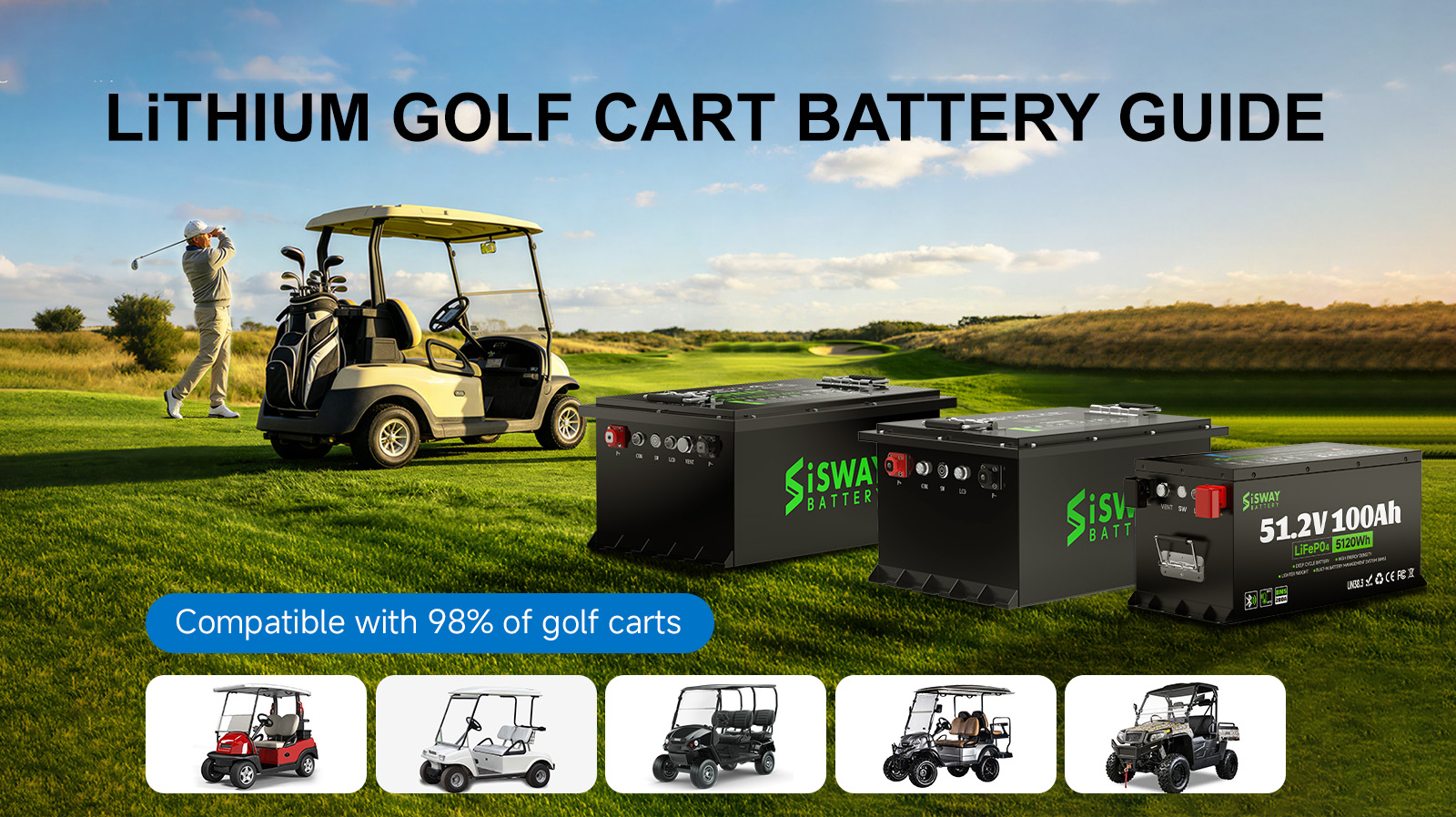
Introduction
Whether you’re cruising fairways, navigating your neighborhood, or running a resort fleet — your golf cart is only as good as its battery. Choosing the wrong one means sluggish performance, frequent replacements, and wasted money. This guide covers everything you need to make the smartest battery decision possible.
Why the Right Golf Cart Battery Matters
Golf cart batteries are not a one-size-fits-all product. The battery pack is the heartbeat of any electric golf cart — it determines range, top speed, hill-climbing ability, and how long your cart stays in service before a costly replacement.
Most American golfers and golf cart owners replace their batteries every 4–7 years, depending on usage, climate, and maintenance habits. Getting it right from day one can save you hundreds — even thousands — of dollars over a cart’s lifetime.
At Sisway Battery, we’ve helped thousands of customers across the U.S. find the right battery for their Club Car, EZ-GO, Yamaha, and custom builds. This guide distills everything we know into one actionable resource.
Types of Golf Cart Batteries Explained
There are three main battery chemistries on the market today. Understanding the difference is the first step to making the right choice.
Flooded Lead-Acid (FLA) — The Traditional Workhorse
Flooded lead-acid batteries have powered golf carts since the beginning. They’re the most affordable option upfront and are widely available at battery retailers and golf cart dealers across the U.S.
- Proven technology with decades of real-world track record
- Lowest purchase price per battery
- Require regular watering (distilled water) every 2–4 weeks
- Produce hydrogen gas during charging — needs proper ventilation
- Heavier than newer alternatives
- Typical lifespan: 4–6 years with proper maintenance
AGM (Absorbed Glass Mat) — Maintenance-Free Convenience
AGM batteries are sealed, meaning no watering required and no acid spills. They’re a popular middle-ground for golf cart owners who want reliability without the upkeep of FLA.
- Completely sealed and spill-proof
- No maintenance required
- Handles vibration better than flooded batteries
- Slightly more expensive than FLA
- More sensitive to overcharging
- Typical lifespan: 4–7 years
Lithium-Ion (LiFePO4) — The Modern Performance Choice
Lithium iron phosphate batteries have taken the golf cart world by storm, and for good reason. While the upfront cost is higher, the long-term value is exceptional.
- Up to 2–3x longer lifespan than lead-acid (8–15 years)
- 50–70% lighter than lead-acid equivalents
- Faster charging — often fully charged in 2–4 hours
- Zero maintenance required
- Consistent performance throughout the entire charge cycle
- Higher upfront cost, but lower total cost of ownership
| Sisway Pro Tip If you plan to keep your golf cart for 5+ years and use it regularly, lithium is almost always the better financial decision in the long run — even with the higher purchase price. |
Understanding Golf Cart Battery Voltage
Golf carts run on battery packs that total either 36 volts or 48 volts. The total voltage is achieved by wiring multiple smaller batteries in series. Here’s how it breaks down:
| System Voltage | Battery Config | Common For | Performance |
| 36V | Six 6V batteries | Older Club Car, EZ-GO | Adequate for flat terrain |
| 48V | Six 8V batteries | Most modern golf carts | Better torque & range |
| 48V | Four 12V batteries | Utility & neighborhood | Easier battery sourcing |
| 72V | Six 12V batteries | Performance & custom builds | High speed & hills |
Always match the total voltage to your cart’s system voltage. Mixing voltages or installing the wrong configuration can damage your controller, motor, and charger. If you’re unsure, contact the Sisway Battery team — we’ll help you identify the right setup for your specific cart model.
Lead-Acid vs. Lithium: Head-to-Head Comparison
| Feature | Flooded Lead-Acid | AGM Lead-Acid | Lithium (LiFePO4) |
| Upfront Cost | $ Low | $$ Moderate | $$$ High |
| Lifespan | 4–6 years | 4–7 years | 8–15 years |
| Weight | Heavy | Heavy | 50–70% lighter |
| Maintenance | Required (watering) | None | None |
| Charge Time | 8–10 hours | 6–8 hours | 2–4 hours |
| Performance Drop | Yes (as discharged) | Yes (as discharged) | No (flat curve) |
| Range per Charge | 15–25 miles | 20–28 miles | 30–50+ miles |
| Depth of Discharge | 50% recommended | 50–60% | 80–100% safe |
| Long-Term Value | Lower | Moderate | Higher |
Golf Cart Battery Maintenance Guide
Even the best battery will fail prematurely without proper care. Here’s what every golf cart owner in America should know:
For Flooded Lead-Acid Batteries
- Check water levels monthly. Use only distilled water. Never use tap water — minerals can corrode the plates. Fill only to the recommended level line (never above).
- Charge after every use. Deep-cycle batteries should not be left in a discharged state. Plug in your charger after every ride, even short ones.
- Clean terminals regularly. Use a baking soda and water mixture with a stiff brush to remove corrosion. Apply anti-corrosion spray or petroleum jelly to terminals after cleaning.
- Equalize charge every 30–45 days. This controlled overcharge balances all cells and prevents sulfation. Most modern chargers have an equalization mode.
- Store properly in winter. Keep batteries fully charged during storage. Cold storage is fine, but never store a discharged battery — it will freeze and crack.
| Pro Tip: The 50% Rule For lead-acid batteries, try never to discharge below 50% of capacity. Regularly deep-discharging these batteries dramatically shortens their life. Many golf cart owners install a battery meter to monitor state of charge. |
For Lithium Batteries
Lithium batteries are essentially maintenance-free. No watering, no equalization, no terminal cleaning needed. Their built-in Battery Management System (BMS) handles cell balancing automatically. Simply charge after each use and store at a 50–80% charge level if storing for extended periods.
Signs Your Golf Cart Battery Needs Replacing
Don’t wait until your cart dies on the 9th hole. Watch for these warning signs:
- Noticeably reduced range — cart runs out of charge sooner than it used to
- Slow acceleration or loss of power going uphill
- Batteries feel excessively hot after charging
- Bulging, swollen, or cracked battery cases
- One or more batteries won’t hold a charge even after equalization
- Visible corrosion or sulfation (white crystal buildup) on terminals
- Cart charger clicks off immediately or very quickly after charging begins
- Batteries are 4–6 years old (lead-acid) or 10+ years old (lithium)
| Important Note Always replace all batteries in your golf cart at the same time. Mixing new and old batteries causes the new ones to compensate for the old ones, dramatically shortening the life of your new investment. |
How to Choose the Right Golf Cart Battery
Follow this simple decision framework before making your purchase:
- Identify your cart’s system voltage. Check your owner’s manual, the existing battery labels, or the cart’s nameplate. Common systems are 36V or 48V.
- Determine the battery configuration. Count how many batteries are in your pack and their individual voltage (6V, 8V, or 12V).
- Consider your usage pattern. Daily drivers or commercial fleet carts benefit most from lithium. Occasional weekend golfers can do very well with quality lead-acid.
- Calculate your budget — short-term vs. long-term. Lead-acid is cheaper upfront. Lithium costs more initially but often costs less over 10 years when you factor in replacement cycles.
- Check physical dimensions. Batteries must fit in your cart’s battery tray. Always verify the dimensions of the replacement against available space.
- Verify charger compatibility. Lithium batteries require a lithium-compatible charger. Using a standard lead-acid charger with lithium batteries is a safety hazard.
FAQ
Lead-acid: 4–6 years, AGM: 4–7 years, Lithium: 8–15 years. Lifespan depends on usage and maintenance.
Lead-acid: $500–$1,200, AGM: $700–$1,400, Lithium: $1,500–$4,000+.
Yes. You’ll need a compatible charger and possibly new mounts. Performance improves significantly.
After every use for best battery life.
Low water damages plates, reduces capacity, and can cause failure.
For most modern uses, yes. 48V systems deliver more torque, better hill-climbing ability, and greater overall range. Most new golf carts sold in America today are 48V. If you have an older 36V cart and want more performance, it is possible to convert to 48V, but it requires a new motor, controller, and charger.
Conclusion
Ready to Power Up Your Golf Cart ?
Shop Sisway Battery’s full range of lithium golf cart batteries lithium — with expert support and fast shipping across the USA And word wild. Visit: www.siswaybattery.com