

Table of Contents
Picking the right 48V lithium battery is not just about voltage. Capacity, physical size and discharge rating all decide how well the pack suits your cart. A pack that is too small runs out early. A pack that is too large costs more than you need.
This guide shows how to size a lithium pack step by step. You will learn how to read Ah and kWh, estimate your daily energy use and match the battery to your cart.
1. What Does Size Mean for a 48V Lithium Battery?
Buyers use the word “size” for three different things. Each one matters, so check all three before you order.
Three Kinds of Size
- Electrical size: Voltage and capacity (Ah), which set how much energy the pack stores.
- Physical size: Length, width, height and weight, which decide whether it fits your tray.
- Power size: The BMS discharge rating, which decides whether the pack can supply your motor controller.
2. Start With Voltage: 48V vs. 51.2V
Your cart’s system voltage is fixed, so it comes first. A 48V cart needs a 48V-class lithium pack. In practice, that means a LiFePO4 pack with 16 cells in series, which has a nominal voltage of 51.2V.
Do not worry about the “extra” 3.2V. The motor and controller are designed for this range. However, a 36V or 72V cart needs a different pack entirely. If you are unsure which system you have, count the lead-acid batteries and add up their voltages. Six 8V batteries make a 48V system.
3. Capacity in Ah and kWh
Capacity tells you how long the cart can run. Amp-hours (Ah) show the charge a pack holds. Kilowatt-hours (kWh) show the energy. To convert, multiply Ah by 51.2V and divide by 1,000.
| CAPACITY | APPROX. ENERGY | TYPICAL FIT |
|---|---|---|
| 50Ah | ~2.6 kWh | Light, short-distance use |
| 100Ah | ~5.1 kWh | Standard course and neighborhood use |
| 150Ah | ~7.7 kWh | Daily use, hills and extra passengers |
| 200Ah | ~10.2 kWh | Heavy-duty, lifted carts and fleets |
Available sizes vary by model, so check the product page for the exact options. Real-world range depends on many factors. For details, read our guide on how far a 48V pack goes on a single charge.
4. How to Calculate the Size You Need
You can estimate the right capacity with a simple four-step method. It takes only a few minutes.
A Simple Four-Step Method
- Find your daily distance. Use a trip meter or your usual route. For example, 15 miles.
- Estimate energy per mile. A planning figure is about 0.2 to 0.35 kWh per mile. Use the higher end for hills, lifted carts and heavy loads.
- Multiply. 15 miles at 0.25 kWh per mile needs about 3.75 kWh.
- Add a 20% reserve. This gives about 4.7 kWh, so a 100Ah pack (~5.1 kWh) is a good match.
Verify With a Real-World Test
Energy use varies with tires, terrain and driving style. Therefore, treat these numbers as a starting point. Drive your usual route and note how much charge is left. Then adjust your estimate and, if in doubt, size up one step.
5. Matching Size to Your Cart and Use
Different carts place different demands on the pack. Use this table as a quick filter.
| CART TYPE | USAGE | SUGGESTED CAPACITY |
|---|---|---|
| Standard 2-seater | One or two rounds, flat terrain | 100Ah |
| Neighborhood or community cart | Daily errands, frequent stops | 100Ah to 150Ah |
| 4-seater or 6-seater | Extra passengers and weight | 150Ah or more |
| Lifted or off-road cart | Large tires, hills, uneven ground | 150Ah to 200Ah |
| Fleet, resort or utility cart | Long shifts with little downtime | 200Ah, or a custom pack |
These are general suggestions, not fixed rules. If your cart does not fit any row, our team can recommend a size based on your usage.
6. Check Dimensions and Weight
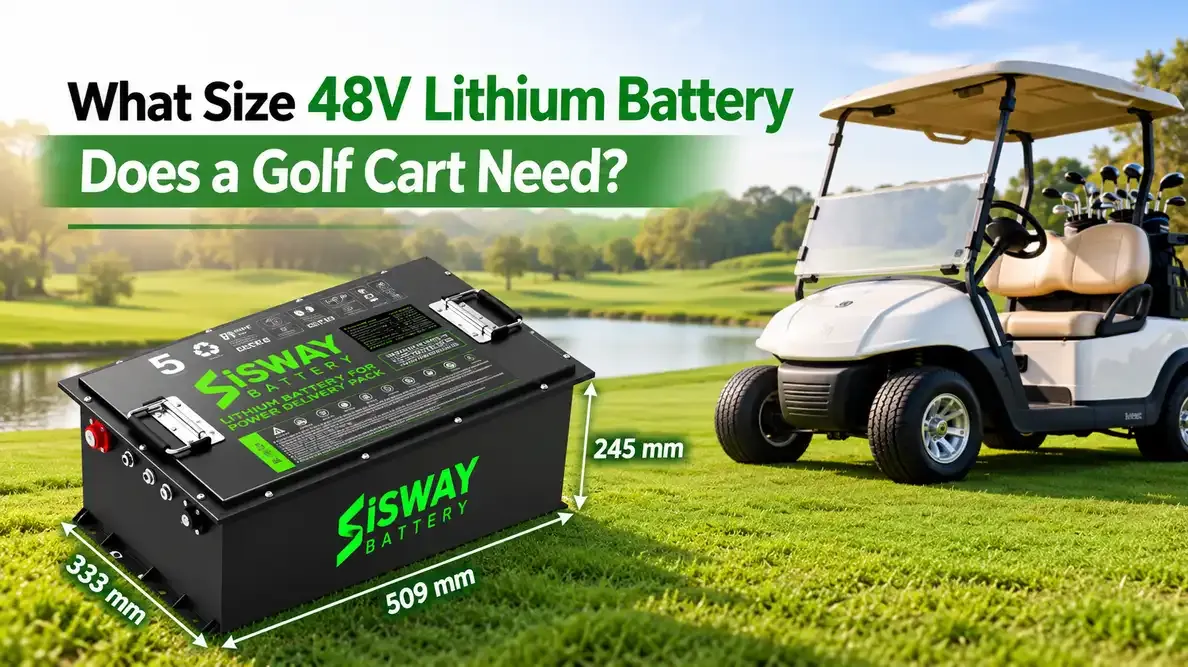
Even the right capacity is useless if the pack does not fit. A lithium pack is usually more compact than six lead-acid batteries. As a result, it may sit in a larger tray with room to spare.
Measure Before You Order
- Measure the tray’s length, width and height, including any lid or seat clearance.
- Compare these numbers with the pack’s listed dimensions.
- Check the terminal position so the cables reach without stretching.
- Plan how to secure the pack, using a bracket or spacer if the tray is larger.
Weight is rarely a problem. Lithium is far lighter than a lead-acid bank, so the cart handles better and puts less strain on the suspension.
7. Match the BMS to Your Controller
The Battery Management System (BMS) limits how much current the pack can deliver. Your motor controller pulls current, especially during acceleration and hill climbs. If the BMS rating is too low, the pack may cut power under load.
What to Compare
- Continuous discharge: Should cover your cart’s normal running current.
- Peak discharge: Should meet or exceed your controller’s peak current.
- Charge current: Decides which charger you can use. See our charging time guide for details.
Lifted carts and high-speed builds often draw more current. For these, confirm the BMS specification before you buy.
8. Common Sizing Mistakes to Avoid
Buying on Ah Alone
A high Ah number looks impressive, but it ignores fit and discharge rating. Always check all three kinds of size.
Sizing for Your Best Day Only
Plan for your hardest regular day, not your easiest. Hills, passengers and cold weather all reduce range.
Forgetting the Charger and Gauge
A new pack needs a LiFePO4 charger. In addition, an old lead-acid gauge may misread lithium, so a compatible state-of-charge meter is worth adding. Browse our golf cart chargers to find the right match.
Overbuying Without a Reason
Extra capacity adds cost. If your daily use is modest, a mid-size pack with a good reserve is often the smartest value. For a wider checklist, read our 48V golf cart battery buying guide.
Find the Right 48V Battery for Your Cart
Sisway builds 48V LiFePO4 packs with BMS protection for golf carts, resorts and utility vehicles. Tell us your cart model and daily use, and we will help match capacity, mounting fit and charger. For special requirements, ask about our OEM/ODM services.
Browse the 48V Lithium Range