
Table of Contents
- 1. Introduction
- 2. What Is an 80V Forklift Battery?
- 3. Why Choose an 80V Lithium Forklift Battery?
- 4. 80V Lithium Forklift Battery vs Lead-Acid Battery
- 5. How to Choose the Right 80V Forklift Battery
- 6. 80V Forklift Battery Capacity Options
- 7. Applications of 80V Forklift Batteries
- 8. Charging and Maintenance Tips
- 9. Why Choose Sisway Battery for 80V Forklift Batteries?
- 10. Frequently Asked Questions
In the fast-paced world of material handling, operational efficiency, reliability, and cost-control are paramount. Industrial facilities, logistics providers, and manufacturing plants constantly seek ways to optimize their fleets, minimize vehicle downtime, and maximize throughput. A key component driving this evolution is the power source running the equipment. Heavy-duty material handling operations rely on high-voltage systems to maintain performance under strenuous conditions. The 80V Forklift Battery has emerged as the standard-bearer for heavy-capacity Class I electric forklifts, offering the high torque and runtime required for intensive industrial applications.
Modern warehouses are moving away from legacy technologies to meet stricter environmental targets and reduce operating costs. Upgrading to an 80V Lithium Forklift Battery provides fleet managers with a high-performance alternative to traditional lead-acid systems. By utilizing advanced chemistry, smart battery management, and ultra-fast charging capabilities, these industrial power packs are transforming how warehouses and logistics centers structure their daily operations.
What Is an 80V Forklift Battery?
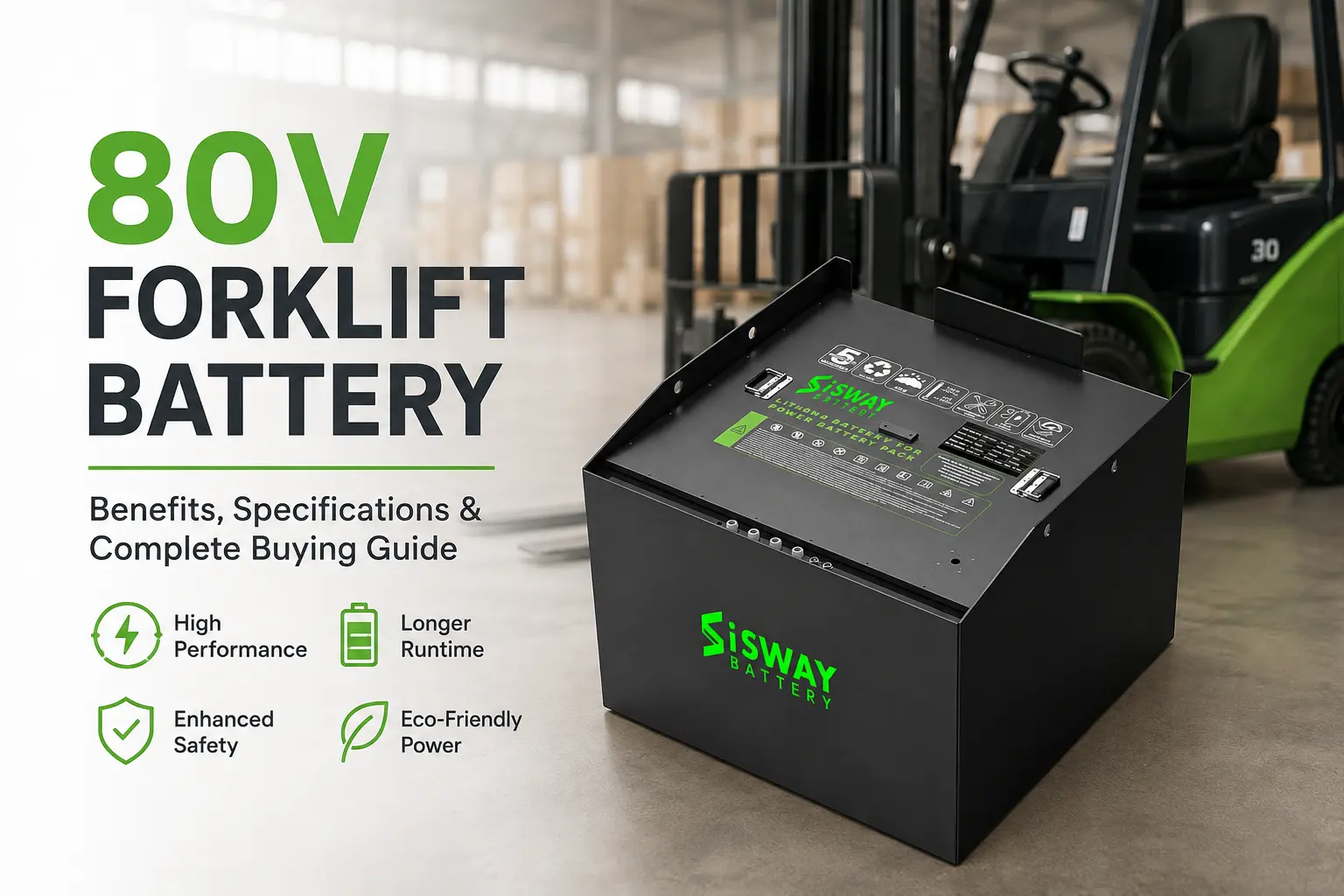
An 80V forklift battery is a high-voltage, high-capacity industrial power source specifically engineered for heavy-duty material handling equipment. These systems typically power Class I electric motor rider trucks, including large counterbalance forklifts, heavy-duty tow tractors, and specialized automated guided vehicles (AGVs). Unlike standard 24V, 36V, or 48V systems designed for light warehouse equipment, an 80V system delivers the electrical currents required to lift heavy tonnages, scale steep ramps, and sustain high travel speeds over extended shifts.
Traditional 80V forklift battery packs consist of heavy lead-acid cells housed in a large steel case that also functions as the forklift’s counterweight. However, modern high-efficiency setups rely on lithium iron phosphate (LiFePO4) chemistry. A high-quality 80V LiFePO4 forklift battery operates at a nominal voltage of 83.2V, delivering continuous, stable electrical current to the forklift’s motors. This high-voltage configuration ensures the machine functions with minimal energy losses, keeping heat generation to a minimum even during continuous high-draw cycles.
Choosing the correct voltage and battery chemistry directly impacts the mechanical longevity of your forklift. The higher operating voltage of an 80V system allows the electrical components to draw lower currents for the same power output, reducing wear and tear on the forklift’s internal wiring, controller, and electric motors.
Why Choose an 80V Lithium Forklift Battery?
Upgrading to an 80V lithium forklift battery represents a significant technological leap forward for material handling operations. While lead-acid batteries have served the industry for decades, their inherent limitations lead to lost productivity and higher maintenance overheads. Choosing a lithium forklift battery provides clear operational advantages:
Lithium batteries deliver 3,000 to 5,000+ full charge/discharge cycles at 80% Depth of Discharge (DoD), easily outlasting lead-acid batteries that degrade after 1,000 to 1,500 cycles.
A full charge is achieved in just 1 to 2 hours. Rapid opportunity charging allows operators to plug in during lunch breaks or shift changeovers without damaging cell health.
Lithium iron phosphate packs eliminate the need for routine battery watering, acid top-offs, and equalization charges, saving hours of manual labor and avoiding hazardous fluid spills.
With energy conversion efficiencies exceeding 95%, lithium cells convert virtually all grid power into motive energy, lowering overall electricity costs and CO2 footprint.
Because batteries do not need to be removed for cooling, swapping, or daily service, fleets operate continuously across multiple shifts using a single battery per vehicle.
Unlike lead-acid units which experience voltage drops as they discharge, lithium maintains constant voltage output and steady hydraulic pressure down to 10% capacity.
80V Lithium Forklift Battery vs Lead-Acid Battery
To help B2B buyers compare the operational impact, the table below highlights the performance, cost, and safety differences between an 80V lithium forklift battery and a traditional lead-acid unit:
| Performance Indicator | Sisway 80V Lithium Battery (LiFePO4) | Traditional Lead-Acid Battery |
|---|---|---|
| Average Cycle Life | 3,000 to 5,000+ cycles (runs up to 10 years) | 1,000 to 1,500 cycles (typical life of 3–5 years) |
| Charging Speed | Fast charging (1–2 hours); plug and play anytime | Slow charging (8 hours charge + 8 hours cooling) |
| Daily Maintenance | Zero maintenance (no water additions, no cleaning) | High maintenance (distilled water refills, cell cleaning) |
| Energy Efficiency | >95% efficiency (low thermal losses) | 70% to 80% efficiency (high heat generation) |
| Voltage Delivery | Flat discharge curve (power stays high until empty) | Steady voltage drop (forklift slows down as charge drops) |
| Operational Safety | Active BMS monitoring; no dangerous gassing | Acid spills risk; hydrogen emissions require venting room |
How to Choose the Right 80V Forklift Battery
Choosing the correct 80V battery configurations requires a detailed understanding of your specific material handling setup. A mismatch can result in reduced vehicle performance, shorter runtime, or even compatibility challenges. Ensure you evaluate the following parameters before investing in new power packs:
- ✔ Battery Capacity (Ah): Evaluate your shifts and peak lifting periods. High-capacity options ensure the forklift runs through multi-shift schedules without requiring mid-shift charging.
- ✔ Forklift Model Compatibility: Counterbalanced forklifts from OEMs (such as Toyota, Linde, Hyster, and Yale) require specific physical designs. Check compatibility to guarantee a seamless drop-in fit.
- ✔ Operating Hours and Shifts: Calculate the hourly duty cycle of your forklifts. Multi-shift, 24/7 facilities require batteries that support rapid, high-amperage opportunity charging.
- ✔ Charging Infrastructure: Ensure your warehouse has sufficient electrical infrastructure to support high-frequency fast chargers designed for lithium systems.
- ✔ Battery Compartment Dimensions & Weight: Electric counterbalance forklifts rely on the battery weight to maintain vehicle stability. Ensure your lithium supplier installs appropriate steel ballast weights inside the battery case to meet the forklift’s minimum weight requirements.
- ✔ Intelligent Battery Management System (BMS): A high-quality BMS is non-negotiable. The BMS manages cell balancing, tracks individual cell temperatures, and communicates telemetry directly to the forklift’s operating system.
- ✔ Application Environmental Requirements: Operations in sub-zero environments, like cold storage food logistics, demand specialized heating blankets within the battery cells to preserve charging efficiency.
80V Forklift Battery Capacity Options
To accommodate varying operational demands, Sisway Battery provides optimized capacity choices for their high-voltage product line. When configuring your 80V motive system, fleet operators can select from the following verified specifications:
- ▪ 80V 460Ah Forklift Battery: This capacity option is ideal for single-to-double shift manufacturing, logistics, and standard warehouse applications. It offers a balanced ratio between charging time and operating cycles, easily powering medium-to-large forklift models under typical load weights.
- ▪ 80V 560Ah Forklift Battery: Engineered for continuous, heavy-duty material handling. This massive energy storage capacity is the preferred choice for 24/7 port terminals, heavy manufacturing plants, cold storage facilities, and high-rack distribution centers where forklifts transport maximum payloads repeatedly.
Choosing the correct capacity guarantees your machinery stays online during your busiest hours. Selecting either the 460Ah or 560Ah configuration ensures your heavy machinery maintains maximum lifting power without experiencing voltage drops.
Applications of 80V Forklift Batteries
High-voltage 80V power systems are deployed in demanding logistics settings worldwide. Thanks to their high energy density, rapid charging, and long cycle life, these batteries are used across diverse industrial sectors:
Charging and Maintenance Tips
Although LiFePO4 forklift batteries require far less care than legacy lead-acid systems, maintaining standard charging protocols helps maximize the life of the cells:
- Implement Opportunity Charging: Encourage operators to connect the battery to the charger during short 15-to-30-minute breaks. Unlike lead-acid units, lithium batteries do not develop memory issues from partial charges.
- Use High-Frequency Chargers: Always charge using original, manufacturer-approved high-frequency smart chargers. These systems communicate directly with the internal BMS to adjust voltage and current output safely.
- Avoid Absolute Depletion: While lithium batteries can safely support high depths of discharge, keeping the state of charge (SoC) above 10% prevents system shutdowns and preserves cell longevity.
- Regular Inspections: Visually inspect the charging cables, connector plugs, and overall chassis for damage or corrosion. Clean the charging pins to ensure a low-resistance electrical connection.
Why Choose Sisway Battery for 80V Forklift Batteries?
Sisway Battery is a leading industrial-grade motive power manufacturer specializing in advanced lithium-ion solutions for heavy material handling. By choosing Sisway Battery as your partner and supplier, you benefit from high-quality design and professional service:
- Advanced Intelligent BMS: Every battery unit is equipped with a custom-engineered Battery Management System that provides active protection against overcharge, over-discharge, short-circuits, and thermal runaway. The system ensures perfect cell balancing to maximize battery lifetime.
- Industry-Leading Certifications: To ensure maximum safety and compliance in industrial environments, Sisway batteries meet globally recognized certifications, including UN38.3, CE, UL, and IEC 62619 / IEC 62133 standards.
- Drop-in Compatibility: Sisway designs physical structures that mimic the original weight and dimensions of traditional lead-acid batteries, guaranteeing a perfect mechanical and electrical fit without vehicle modification.
- Dedicated OEM/ODM Services: Whether you operate a unique fleet or require customized cell layouts, Sisway provides bespoke product adjustments to meet specific voltage, shape, and capacity constraints.
Ready to Upgrade Your Forklift Fleet?
Talk to the engineering experts at Sisway Battery today to configure a high-efficiency lithium power solution tailored for your operations.
View 80V Forklift Battery OptionsFrequently Asked Questions
1. What is an 80V forklift battery?
An 80V forklift battery is a heavy-duty industrial energy storage pack designed for Class I electric motor rider vehicles. It delivers the high operating voltage and current required to run heavy counterbalance forklifts, narrow aisle lift trucks, and tow tractors in heavy material handling applications.
2. What is an 80V lithium forklift battery?
It is an advanced material handling battery that utilizes Lithium Iron Phosphate (LiFePO4) cells instead of lead-acid. Operating at a nominal voltage of 83.2V, it provides benefits such as rapid charging, high electrical efficiency, flat voltage discharge curves, and zero daily maintenance.
3. How long does an 80V forklift battery last?
An 80V lithium forklift battery can last between 3,000 and 5,000+ complete cycles before its capacity drops below 80%. This equates to approximately 10 years of reliable service under normal operational conditions, outlasting lead-acid alternatives by up to three times.
4. Is lithium better than lead-acid for forklifts?
Yes, lithium is generally superior for multi-shift industrial applications. It charges faster, requires no water maintenance, is more energy-efficient, maintains a steady voltage output during discharge, and offers a significantly lower Total Cost of Ownership (TCO).
5. How long does an 80V lithium battery take to charge?
A professional 80V lithium battery can reach a 100% state of charge in 1 to 2 hours when paired with compatible high-frequency industrial chargers. They also support fast opportunity charging during brief coffee or shift breaks without degrading the battery lifespan.
6. What capacity should I choose for an 80V forklift?
The two primary capacity offerings are 460Ah and 560Ah. The 80V 460Ah forklift battery is ideal for standard single-to-double shift warehousing, while the heavy-duty 80V 560Ah forklift battery is recommended for continuous, multi-shift operations handling heavy payloads.
7. Can an 80V forklift battery be customized?
Yes. Sisway Battery provides professional OEM/ODM custom solutions. The steel casing size, counterweight ballast, capacity configurations, and electrical connectors can be tailored to meet the exact dimensions of your forklift brand.
8. What forklifts use 80V batteries?
Heavy counterbalance electric forklifts, large multi-ton trucks, and heavy-duty towing tractors from leading manufacturers such as Linde, Toyota, Crown, Hyster, and Jungheinrich regularly utilize 80V electrical systems to handle demanding operations.
9. How do you maintain an 80V lithium forklift battery?
Lithium forklift batteries do not require watering or venting. Maintenance is limited to basic tasks: performing regular visual checks of cables, maintaining a clean battery casing, checking connectors for dust, and ensuring the battery is connected to a compatible charger.
10. Where can I buy an 80V forklift battery?
You can purchase 80V lithium forklift batteries directly from industrial manufacturers like Sisway Battery. Visually explore their configurations online or submit a detailed project request through their official site to get customized pricing and specs.