
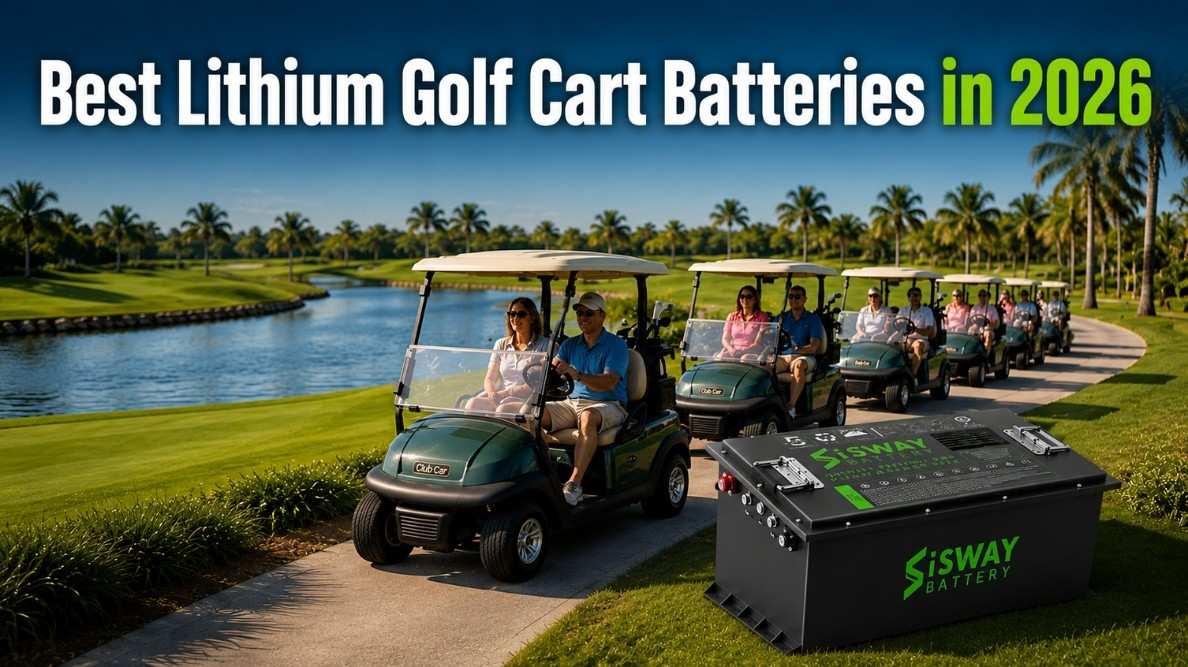
Whether you own a golf cart for weekend rounds, resort transportation, or neighborhood errands, the battery you choose defines your entire riding experience. In 2026, lithium golf cart batteries have become the gold standard — and for good reason. They charge faster, last significantly longer, weigh considerably less, and require virtually zero maintenance compared to traditional lead-acid alternatives.
However, with dozens of products on the market and a wide range of voltages, capacities, and chemistries, finding the best lithium golf cart battery for your specific needs can feel overwhelming. Fortunately, this in-depth guide cuts through the noise — covering everything from top product picks and technical specs to smart buying criteria and real-world cost analysis.
By the end of this article, you will know exactly which golf cart battery suits your cart, your budget, and your usage pattern — so you can invest with complete confidence.
What Is a Lithium Golf Cart Battery?
A lithium golf cart battery is a rechargeable power source built on lithium-ion or lithium iron phosphate (LiFePO4) chemistry, designed specifically to power electric golf carts. Unlike traditional flooded lead-acid or AGM batteries, lithium cells deliver stable voltage throughout the entire discharge cycle. As a result, your cart maintains consistent speed and torque even as the battery drains — a major practical advantage on hilly courses.
LiFePO4: The Chemistry Behind the Best Golf Cart Batteries
Most modern lithium golf cart batteries use LiFePO4 chemistry — widely recognized for its superior thermal stability, long cycle life, and inherent safety compared to other lithium variants. Furthermore, LiFePO4 cells are non-toxic and do not release dangerous gases during operation, making them far safer for enclosed storage areas. These batteries are available in the most common golf cart voltages: 36V, 48V, and 72V systems.
Quick Fact: LiFePO4 batteries can sustain over 3,000 charge cycles while retaining 80% of their original capacity — that’s roughly 8–10 years of regular use, compared to just 2–4 years for standard lead-acid golf cart batteries.
The Role of the Battery Management System (BMS)
In addition to superior cell chemistry, the best golf cart batteries in 2026 come equipped with an integrated Battery Management System (BMS). This intelligent circuit continuously monitors cell voltage, temperature, and current — protecting against overcharging, deep discharge, short circuits, and temperature extremes. Consequently, a quality BMS makes lithium batteries as safe as they are powerful.
Why Switch to Lithium? Key Benefits for Golf Cart Owners
The shift from lead-acid to lithium is one of the most impactful upgrades you can make for your golf cart. Moreover, the advantages go far beyond just longer battery life. Here is why thousands of cart owners are making the switch in 2026:
LiFePO4 cells last 2,000–5,000+ cycles — that is 3 to 5× longer than lead-acid, which ultimately reduces replacement costs over time.
Lithium batteries charge 3–5× faster than lead-acid alternatives. As a result, a full charge in just 2–4 hours means far less downtime and more time on the course.
A lithium battery pack weighs 50–70% less than an equivalent lead-acid set, thereby improving cart performance, range, and motor efficiency.
There is no water topping, no corrosion cleaning, and no equalization charges needed. Lithium batteries are completely maintenance-free throughout their lifespan.
Thanks to a flat discharge curve, you get full power until near-empty — unlike lead-acid batteries, which slow the cart noticeably as they drain.
With no toxic lead or acid, and higher energy efficiency per charge cycle, lithium batteries are a considerably better choice for the environment.
Additional Performance Advantages Worth Noting
Beyond the core benefits listed above, lithium golf cart batteries also perform better in cold weather compared to lead-acid, which loses significant capacity in low temperatures. Additionally, lithium batteries have a much deeper usable depth of discharge — you can safely draw up to 100% of rated capacity, whereas lead-acid should never exceed 50% depth of discharge without shortening its lifespan. Therefore, a 100Ah lithium battery effectively delivers double the usable energy of a 100Ah lead-acid battery in real-world conditions.
Top Lithium Golf Cart Batteries in 2026
After evaluating performance data, user feedback, BMS quality, warranty terms, and overall value for money, here are the standout lithium golf cart batteries to consider in 2026. Notably, each option has been selected to match a specific use case and buyer profile.
1. 48V 100Ah LiFePO4 — Best Overall Choice
The 48V 100Ah LiFePO4 configuration is, without doubt, the most popular choice for standard 48-volt golf carts. It delivers approximately 36–40 miles of range per charge and weighs only 55–65 lbs — compared to 300+ lbs for a full set of 6 lead-acid batteries. Furthermore, its integrated BMS handles cell balancing and multi-layer protection automatically. Cycle life typically exceeds 3,000 full cycles, making this a decade-long investment for average users.
- Voltage / Capacity: 48V / 100Ah
- Cycle Life: 3,000–5,000+ cycles
- Charge Time: Approximately 3–4 hours with a 20A lithium charger
- Weight: Approximately 55–65 lbs
- BMS: Integrated with temperature and overcharge protection
2. 48V 150Ah LiFePO4 — Best for Extended Range
For resort operators, course maintenance teams, or heavy daily users, the 48V 150Ah pack extends range to an impressive 50–60 miles per charge. In addition, the higher amp-hour rating means a slower effective depth of discharge for shorter trips, which further extends overall cell longevity. This makes it an excellent long-term investment for commercial applications.
- Voltage / Capacity: 48V / 150Ah
- Estimated Range: 50–60 miles per charge
- Cycle Life: 3,500+ cycles
- Ideal For: Commercial fleets, resort transportation, heavy daily use
3. 36V 100Ah LiFePO4 — Best Budget-Friendly Option
Many older golf carts — such as the Club Car DS and older EZGO models — operate on 36-volt systems. Consequently, the 36V 100Ah lithium battery is a direct drop-in upgrade that transforms performance and lifespan at a lower entry price than 48V systems. It is therefore perfect for casual golfers who play a round or two per week on relatively flat terrain.
- Voltage / Capacity: 36V / 100Ah
- Estimated Range: 25–35 miles per charge
- Best For: Older cart models, light personal recreational use
- Advantage: Lower upfront cost compared to 48V systems
4. 72V 100Ah LiFePO4 — Best for High-Performance Builds
For lifted, custom, or high-performance street-legal golf carts, the 72V system delivers serious torque and top-end speed. Moreover, it is increasingly popular among golf cart enthusiasts who use their carts on steep hilly terrain or as neighborhood electric vehicles (NEVs). If speed and power are your priorities, this is the configuration to choose.
- Voltage / Capacity: 72V / 100Ah
- Best For: Performance builds, hilly courses, street-legal NEVs
- Cycle Life: 3,000+ cycles
- Benefit: Higher speed and significantly greater torque output
Lithium vs Lead-Acid Golf Cart Batteries: Full Comparison
Still weighing the switch? The following side-by-side comparison covers every major factor that matters to golf cart owners. As you will see, lithium outperforms lead-acid across almost every measurable metric:
| Feature | Lithium (LiFePO4) | Lead-Acid (Flooded) |
|---|---|---|
| Cycle Life | 2,000–5,000+ cycles | 300–500 cycles |
| Weight (48V set) | 55–70 lbs | 300–350 lbs |
| Charge Time | 2–4 hours | 8–12 hours |
| Maintenance | Zero | Regular (water, terminals) |
| Depth of Discharge | Up to 100% safely | Max 50% (damages cells) |
| Usable Energy | ~95–100% | ~40–50% |
| Temperature Range | -20°C to 60°C | Narrow; degrades in cold |
| Upfront Cost | Higher | Lower |
| 10-Year Total Cost | Lower (1–2 replacements) | Higher (4–5 replacements) |
| Environmental Impact | Lower (no lead or acid) | High (toxic materials) |
As this table clearly shows, lithium wins in nearly every performance category. While the upfront cost is higher, the long-term savings are substantial — particularly when factoring in the reduced number of replacements needed over a decade.
How to Choose the Right Lithium Golf Cart Battery
Not every lithium battery is right for every cart or every owner. Therefore, it is essential to evaluate several key factors before you invest in a lithium golf cart battery. Here is a practical checklist to guide your decision:
1. Match Your Cart’s Voltage First
The single most important specification is voltage compatibility. Most carts operate on 36V or 48V systems. Newer high-performance models may use 72V. To confirm your system voltage, check your existing battery pack label or your cart’s motor controller documentation. Installing the wrong voltage can cause irreversible damage to your motor or controller. Therefore, always verify before ordering.
2. Determine the Right Capacity (Ah) for Your Use
Amp-hours (Ah) determine your usable range per charge. Consequently, choosing the right capacity is critical. Use this practical guide based on usage patterns:
- 50–75Ah: Light use — 1–2 rounds per week, flat terrain, under 20 miles per trip
- 100Ah: Standard daily use — moderate terrain, 30–40 miles per trip
- 150Ah: Heavy or commercial use — resort fleets, hilly courses, 50+ miles per day
- 200Ah+: Extreme or industrial use — continuous operation, utility applications
3. Evaluate the BMS Quality Carefully
The Battery Management System (BMS) is, in effect, the brain of any lithium battery. A high-quality BMS should include overcharge protection, over-discharge protection, short circuit protection, thermal management, and active cell balancing. If a supplier cannot clearly document their BMS specifications, that is a significant red flag. In contrast, reputable manufacturers publish full BMS data alongside safety certifications.
4. Confirm Physical Dimensions and Tray Fit
Lithium batteries come in different physical form factors. Therefore, you should measure your battery tray carefully before ordering. Many lithium packs are designed to fit standard EZGO, Club Car, and Yamaha tray sizes — however, you should always confirm the exact dimensions to avoid costly returns. Many suppliers provide model-specific fitment guides upon request.
5. Assess Warranty and Manufacturer Support
A quality golf cart battery should come with a minimum 2-year warranty — ideally 5 years. Beyond that, also verify that the manufacturer provides accessible technical support. Since BMS configuration occasionally requires assistance during initial installation, responsive customer service can make a real difference in your experience after purchase.
Installation & Maintenance Tips for Lithium Golf Cart Batteries
While lithium batteries are maintenance-free during normal operation, proper installation is absolutely critical for both performance and long-term safety. Follow these expert-recommended tips to get the most out of your new battery:
Step-by-Step Installation Best Practices
- First, disconnect the old battery pack completely and discharge any residual energy before removal.
- Next, verify that the new battery voltage matches your cart’s motor and controller specifications exactly.
- Use the correct gauge cables — because lithium batteries can deliver high current, undersized cables cause dangerous heat buildup and voltage drop.
- Secure the battery firmly in the tray to prevent vibration damage to cells or BMS connections during operation.
- Perform an initial full charge before the first use in order to calibrate the BMS state-of-charge display accurately.
- Always use a lithium-compatible charger — standard lead-acid chargers use a different charge profile and can damage lithium cells over time.
- Finally, if your cart has a fuel gauge or charge indicator, check whether a lithium-compatible gauge is needed for accurate readings.
Ongoing Storage and Care Guidelines
- Store the battery at 50–80% charge if the cart will not be used for more than 2–3 months at a time.
- Additionally, avoid storing in temperatures below -10°C or above 45°C for extended periods.
- Periodically inspect cable connections for corrosion or loosening — particularly in humid coastal environments.
- Under no circumstances should you attempt to open or modify the battery casing, as this voids the warranty and creates serious safety risks.
Cost Analysis: Is a Lithium Golf Cart Battery Worth the Investment?
Sticker price is the most common objection to lithium — and understandably so. A quality 48V 100Ah lithium battery pack typically costs $1,200–$2,200, compared to $600–$900 for a full 6-battery lead-acid set. However, that upfront comparison tells only part of the story. To understand the true cost, you need to look at total cost of ownership over time.
10-Year Total Cost of Ownership Breakdown
| Cost Factor | Lithium (10 Years) | Lead-Acid (10 Years) |
|---|---|---|
| Purchase Cost | $1,500 × 1–2 = $1,500–$3,000 | $750 × 4–5 = $3,000–$3,750 |
| Maintenance Cost | $0 | $200–$400 (water, terminals) |
| Energy Efficiency Savings | ~30% less electricity consumed | Baseline |
| Estimated Total (10 yrs) | $1,500–$3,000 | $3,200–$4,150 |
What the Numbers Actually Mean for You
The numbers tell a clear and compelling story: over a 10-year horizon, lithium is typically 30–50% cheaper in total cost of ownership. And that calculation does not even account for the performance advantages — faster charging, longer range per charge, and a lighter cart that is easier on tires, brakes, and suspension components.
For commercial operators — including golf courses, resorts, retirement communities, and rental fleets — the return on investment is even more compelling. Furthermore, reduced downtime due to faster charging directly translates to higher operational capacity. Explore our range of lithium golf cart batteries built specifically for demanding commercial cycles.
Expert Industry Insight
“The conversation around golf cart batteries has fundamentally shifted in recent years. Previously, fleet operators asked whether lithium was reliable enough. Today, however, they are asking which lithium chemistry best suits their specific cycle demands. LiFePO4 has essentially become the industry standard — the reliability data is simply too compelling to ignore. Moreover, total cost of ownership calculations consistently favor lithium over any 5-year or longer planning horizon.”
— Battery Systems Engineer, Electric Vehicle Fleet Industry
Conclusion
In 2026, there is no question that lithium golf cart batteries represent the best available technology for powering electric golf carts — whether for personal recreational use, commercial resort fleets, or utility transportation on large properties. The combination of long lifespan, fast charging, lightweight construction, zero maintenance, and favorable long-term economics makes lithium the clear and logical choice for any serious cart owner.
Ultimately, the key is matching the right voltage and capacity to your specific cart and usage pattern. A 36V 100Ah battery suits most casual golfers with older carts. The 48V 100Ah is the sweet spot for standard daily personal and light commercial use. Heavy commercial operators, on the other hand, should look at 48V 150Ah or higher. Additionally, performance enthusiasts building high-speed or hilly-terrain carts will benefit most from a 72V system.
Whatever your needs, investing in a quality golf cart battery with a robust BMS, clear safety certifications, and a strong manufacturer warranty will pay dividends for many years to come. Therefore, take the time to choose wisely — and enjoy the performance upgrade.
Ready to upgrade your golf cart to lithium power?
Shop Lithium Golf Cart BatteriesFrequently Asked Questions
Everything you need to know about lithium golf cart batteries — answered in detail.